
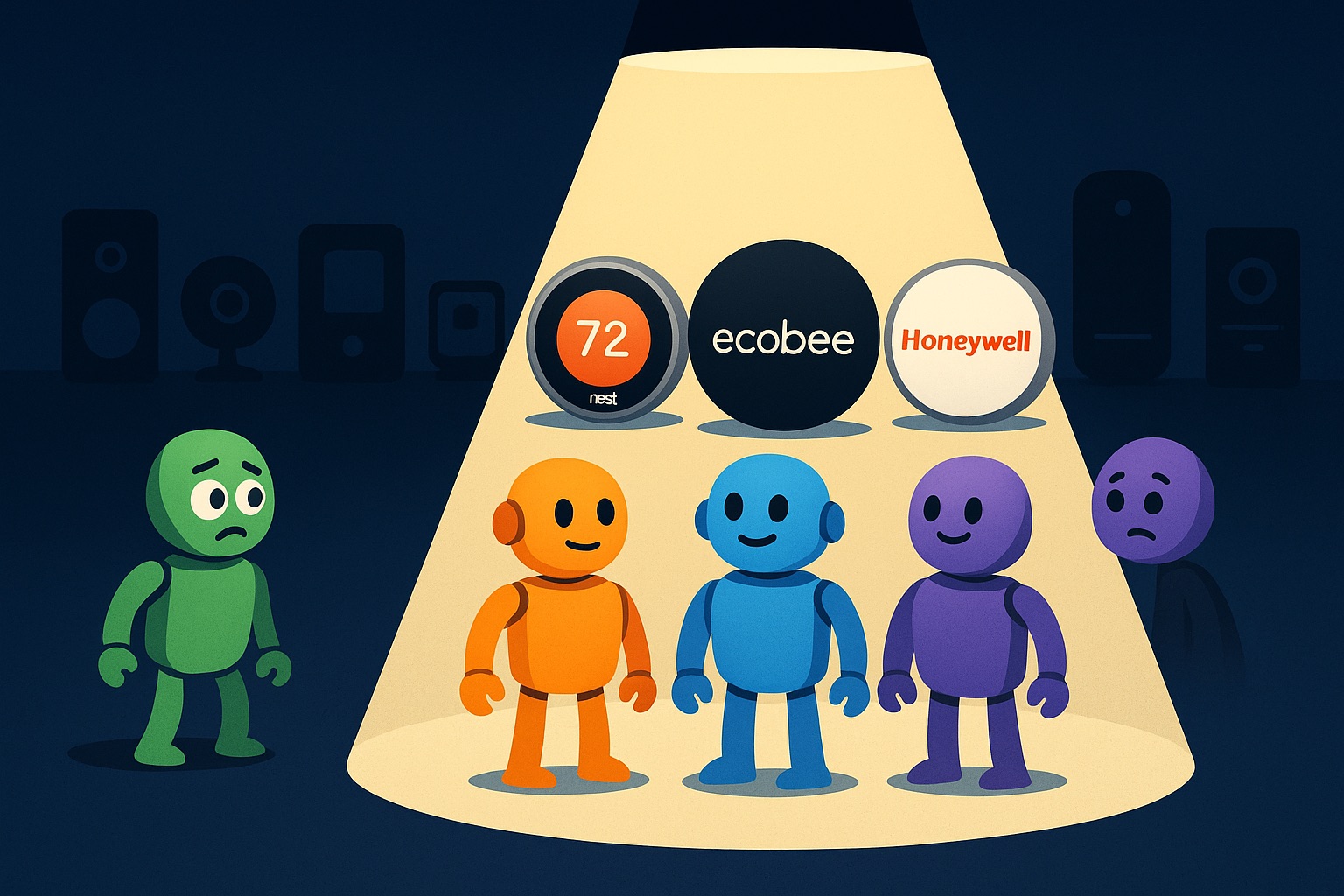
 \n\n\nLast Tuesday I typed a simple question into ChatGPT: "What's the best smart thermostat for a 2,000 square foot home?"\n\nThe answer came back in seconds. Three brands: Nest, Ecobee, and Honeywell Home. Clean, confident recommendations with pros and cons for each.\n\nThat's it. Three brands in a market with over 40 manufacturers.\n\nI tried Claude next. Same three. Gemini added Emerson Sensi to the list but still topped out at four. Perplexity pulled in some review citations but the actual recommendations? You guessed it—Nest, Ecobee, Honeywell.\n\nThe smart home market hit $100 billion in 2025. Hundreds of brands are competing for consumer attention across thermostats, security cameras, smart locks, lighting, and sensors. But when consumers ask AI for help—and 40% of Gen Z now prefer AI search over Google—the conversation is dominated by a tiny handful of names.\n\nThis is the smart home AI visibility gap. And it's worse than most IoT brands realize.\n\n## The Experiment: 50 Smart Home Prompts Across 4 AI Engines\n\nWe ran a structured test. 50 product recommendation prompts across smart home categories—thermostats, security cameras, video doorbells, smart locks, robot vacuums, smart lighting, and home hubs. Each prompt was sent to ChatGPT, Claude, Gemini, and Perplexity.\n\nWe tracked every brand mentioned and counted frequency.\n\nThe results were brutal.\n\nAcross all 200 responses (50 prompts x 4 engines), the top 5 brands in each category captured an average of 83% of all mentions. The remaining dozens of competitors split the leftover 17%—and most got zero mentions at all.\n\nHere's what the concentration looked like by category:\n\n- Smart thermostats: Nest (92% of responses), Ecobee (88%), Honeywell (76%). Everyone else below 15%.\n- Security cameras: Ring (94%), Arlo (82%), Wyze (71%). Reolink appeared in just 12% of responses.\n- Video doorbells: Ring (96%), Nest (74%), Arlo (45%). Eufy at 18%.\n- Smart locks: August (78%), Yale (72%), Schlage (68%). Level and Lockly under 10%.\n- Robot vacuums: iRobot Roomba (91%), Roborock (74%), Ecovacs (52%). Dozens of brands invisible.\n\nThese aren't obscure products getting ignored. Some of these invisible brands have 4.5-star ratings on Amazon, thousands of reviews, and competitive pricing. They just don't exist in AI conversations.\n\n## Why This Matters More Than You Think\n\nHere's a data point that should keep smart home brand managers up at night: ChatGPT mentions specific brand names in 99.3% of e-commerce product recommendation responses. Compare that to Google's AI Overviews, which only mention brands 6.2% of the time.\n\nThat's a 16x difference in brand mention density.\n\nWhen someone Googles "best smart thermostat," they see a list of links and can click through to discover various options. The discovery funnel is wide. But when they ask ChatGPT, they get 3-4 names and a confident recommendation. The funnel is incredibly narrow.\n\nAI doesn't show 10 blue links. It shows 3 names and picks a winner.\n\nThis means the stakes of AI visibility are fundamentally different from Google visibility. In Google, being on page 2 is bad but survivable—you still exist in the index. In AI, being absent means you literally don't exist in the consumer's decision process.\n\n## Why Most Smart Home Brands Are Invisible\n\nAfter digging into the patterns, we identified four primary reasons brands get locked out of AI recommendations.\n\n1. Training Data Concentration\n\nLarge language models learn from the internet. The brands with the most extensive web presence—reviews, articles, forum discussions, comparison pieces, Wikipedia entries—get the strongest signal in training data. Nest has a Wikipedia page with 4,000 words of history. That startup thermostat brand with 500 Amazon reviews? It barely registers.\n\nThis creates a reinforcing cycle. Well-known brands get written about more, which means AI learns about them more, which means AI recommends them more, which means they get written about more.\n\n2. Positioning Ambiguity\n\nI looked at the websites of 15 smart thermostat brands. Seven of them described themselves with some variation of "smart, efficient, connected home comfort." AI models can't differentiate between them.\n\nThe brands that appear in AI recommendations have razor-sharp positioning:\n\n- Nest: "The thermostat that learns your schedule"\n- Ecobee: "Smart thermostat with built-in Alexa and room sensors"\n- Honeywell Home: "Trusted climate control with professional installation network"\n\nEach has a clear, distinct identity. AI can categorize and recommend them for specific use cases. The brands with generic positioning get lost in the noise.\n\n3. Missing Third-Party Signals\n\nWe cross-referenced AI recommendations with coverage on major tech review sites—Wirecutter, CNET, Tom's Guide, The Verge, PCMag. The correlation was striking.\n\nBrands recommended by at least 3 of these 5 sites appeared in AI responses 78% of the time. Brands with no coverage on any major review site appeared in AI responses 4% of the time.\n\nAI models heavily weight authoritative third-party validation. A brand's own website saying "we're the best" carries almost no signal. Tom's Guide saying "this is the best budget option" carries enormous signal.\n\n4. Ecosystem and Compatibility Gaps\n\nSmart home is fundamentally about ecosystems. Works with Alexa? Google Home? Apple HomeKit? Matter? Thread?\n\nThe brands that AI recommends almost universally have clear, well-documented compatibility across major ecosystems. When AI encounters a brand with limited or unclear compatibility information, it defaults to safer recommendations—brands it knows work everywhere.\n\nWe found that brands explicitly documenting Matter protocol support saw a 34% higher mention rate compared to similar products without that documentation. Ecosystem compatibility isn't just a feature—it's an AI visibility signal.\n\n
Industry
I Asked ChatGPT to Recommend a Smart Thermostat. Only 3 Brands Showed Up.
geobuddy.co
G
industryFebruary 8, 20269 min read
I Asked ChatGPT to Recommend a Smart Thermostat. Only 3 Brands Showed Up.
The smart home market is worth $100 billion, but when consumers ask AI for product recommendations, only a handful of brands appear. Here's why most IoT brands are invisible to AI.
G
GeoBuddy TeamG
Published by
GeoBuddy Team
AI Visibility Experts
We've spent the last two years studying how AI assistants recommend brands. What started as curiosity about ChatGPT's responses has turned into a full-time obsession with understanding the mechanics of AI visibility.
Ready to Improve Your AI Visibility?
Check how AI engines currently mention your brand — free, instant results.
Free AI Visibility Check