
The SEO Tool AI Leaderboard: 34 Tools Ranked — And the Irony That Most SEO Tools Are Invisible to AI
We queried ChatGPT, Claude, Gemini, and Perplexity about SEO tools across 12 different prompts per brand. The result is the most comprehensive AI visibility ranking of the SEO tool industry ever published — and the findings are devastating.
The punchline writes itself:
SEO tools — the products that help businesses get found in search — are themselves invisible to AI search. Fifty percent of them. Completely. Zero mentions across all four major AI engines.
It's as if a locksmith couldn't get into their own house.
We analyzed 34 SEO tools across ChatGPT, Claude, Gemini, and Perplexity using 12 different prompts per brand — 408 total AI queries. Each brand was tested against questions like "What are the best SEO tools?", "I need to improve my website's ranking, what do you recommend?", and "Top SEO platforms compared."
The methodology is straightforward: we measured how often each tool gets mentioned, what role AI assigns it (primary recommendation, alternative, or neutral comparison), and how positively the AI speaks about it. This is the same framework we've applied to e-commerce platforms, coffee chains, and 1,548 other brands across dozens of industries.
What we found in the SEO tool category is, frankly, embarrassing for the industry.
The Full Ranking: 34 SEO Tools, Sorted by AI Visibility
The top score in the entire SEO tool industry is 67%. To put that in perspective, Shopify scores 100% in e-commerce. Duolingo scores 92% in language learning. The best SEO tool barely manages two-thirds visibility.
And it gets worse from there. The distribution isn't a gradual decline — it's a cliff. After the top 7 tools (all at 50%+), there's a sharp drop to the mid-tier, then a massive wall of zeros.
The SEO Tool AI Visibility Leaderboard: All 34 Brands Ranked
Green = Top Tier (40%+) · Blue = Visible (40-50%) · Orange = Mid (25-33%) · Red = Low (8%) · Gray = Invisible (0%)
Let's break down the tiers:
- Top Tier (50-67%): Google Keyword Planner, Ubersuggest, AccuRanker, SpyFu, Moz Pro, Screaming Frog, RankMath. These 7 tools account for nearly all meaningful AI visibility in the SEO tool space.
- Mid Tier (25-42%): Surfer SEO, AnswerThePublic, SE Ranking, Siteliner. Mentioned sometimes, but inconsistently.
- Bottom Tier (8%): Serpstat, Keyword Tool, CognitiveSEO, SEO PowerSuite, Screpy, SEOquake. A single mention across 12 prompts.
- Invisible (0%): 17 brands. SISTRIX, Mangools, Long Tail Pro, Raven Tools, Nightwatch, Seobility, and 11 others. Zero. Across all engines. All prompts. Nothing.
The Irony Index: Search Experts Who Can't Be Found
SEO tools average 16.4% AI visibility. That's below the global average of 18.1% across all 1,548 brands in our database. Let that sink in.
The companies that sell "get found in search" as their core value proposition are themselves less visible in AI search than the average brand across all industries. Coffee chains (27.8%) outperform them. E-commerce platforms (37.2%) more than double them. Cloud storage services (66.8%) quadruple them.
The Irony Index: SEO Tools vs Other Industries
Average AI visibility by industry. SEO tools — the search optimization experts — score below the global average.
Why this matters for SEO professionals:
If your SEO tool vendor can't figure out AI visibility for their own brand, should you trust them to help you figure it out for yours? This isn't just an academic observation — it's a market signal. The shift from traditional SEO to AI-optimized search (GEO) is happening, and most of the industry's own tools haven't adapted.
The Elephants Not in the Room: Where Are Ahrefs and Semrush?
Sharp-eyed readers will notice two glaring absences: Ahrefs and Semrush, the undisputed kings of the SEO software market.
They're not missing — they're in a different league. In our taxonomy, Ahrefs and Semrush are classified as "all-in-one SEO platforms" rather than specialized SEO tools. And in their category, they dominate AI recommendations the way Shopify dominates e-commerce. They appear in virtually every AI response about SEO, always ranked #1 or #2.
This actually makes the picture more damning for the other 34 tools: AI doesn't just have a top-2 bias — it has a top-2 monopoly. When someone asks "What are the best SEO tools?", the AI says "Ahrefs and Semrush" and then maybe mentions a couple of others as afterthoughts. The remaining 30+ tools fight over crumbs.
The Moz Paradox: Why Brand Legacy Doesn't Equal AI Preference
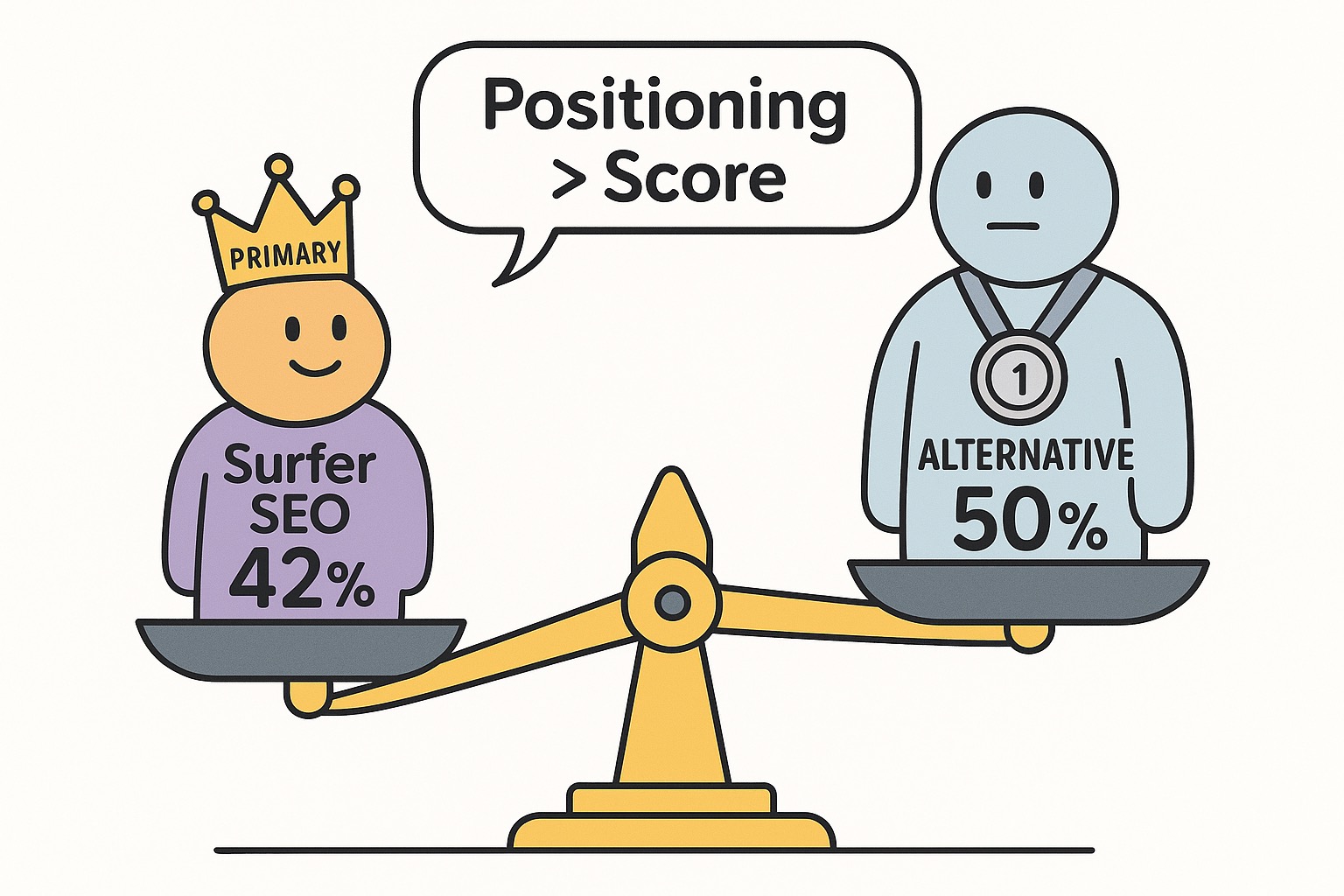
Moz Pro scores 50% visibility. Surfer SEO scores 42%. Moz wins on raw numbers. But dig deeper, and the story flips.
Moz is the inventor of Domain Authority and Page Authority — two metrics that defined an entire era of SEO. Rand Fishkin's Whiteboard Friday videos educated a generation of SEOs. Moz's brand legacy is unmatched.
Yet when AI mentions Moz, it consistently labels it as an "alternative" — the second choice, never the first pick. It always comes after Ahrefs and Semrush. "Moz Pro is good, but..."
Surfer SEO, with 8 percentage points less visibility, earns "primary recommendation" status. When the prompt is about content optimization specifically, AI says: "Use Surfer SEO." Not "consider it as an alternative." Use it.
Moz Pro vs Surfer SEO: The Brand Legacy Paradox
Moz has higher visibility (50%) but is always 'alternative'. Surfer SEO has lower visibility (42%) but earns 'primary'.
The lesson here is strategic:
Moz spread itself thin trying to be an all-in-one platform (competing with Ahrefs/Semrush) and became "the third option" in AI's mind. Surfer SEO focused on one thing — content optimization — and became the AI's go-to for that specific use case. In AI search, niche authority beats broad recognition.
How AI Categorizes SEO Tools: The Role Breakdown
Only 5 out of 34 SEO tools (15%) earn "primary recommendation" status from any AI engine. The rest are either alternatives, neutral comparisons, or — for half of them — completely unknown.
How AI Categorizes SEO Tools: Role Distribution
50% of SEO tools (17 out of 34) are completely invisible to all 4 AI engines
The primary tools are: Google Keyword Planner, Screaming Frog, RankMath, Surfer SEO, and SEO PowerSuite (the last one only via a single ChatGPT mention). What do the first four have in common? They each own a distinct niche:
- Google Keyword Planner → keyword research (backed by Google's brand)
- Screaming Frog → technical site crawling
- RankMath → WordPress SEO plugin
- Surfer SEO → content optimization scoring
The pattern is clear: generalist tools become "alternatives." Specialist tools become "primary." AI rewards focus. We've seen this same pattern across every industry we've analyzed.
Sentiment: Who Gets the Love (and Who Gets the "It's Fine")
AccuRanker has the highest sentiment score (0.66) of any SEO tool. When AI mentions it, the language is notably warm: "excellent reporting features," "fast updates," "comprehensive rank tracking." This is unusual — most tools get the clinical, Wikipedia-like treatment.
AI Sentiment Toward SEO Tools: Who Gets the Warm Fuzzy Feelings?
Average sentiment score when mentioned (0 = neutral, 1 = very positive). Only tools with >0% visibility shown.
At the bottom: SEO PowerSuite with 0.15 sentiment. It got mentioned once by ChatGPT with the tone of a Wikipedia stub — facts only, no enthusiasm. Surfer SEO is also surprisingly low (0.39) despite being a primary recommendation. AI recommends it but doesn't gush about it. It's a "this is what you should use" without the "and here's why it's amazing."
Sentiment ≠ Visibility ≠ Role
These three metrics are surprisingly independent. AccuRanker has the highest sentiment but isn't consistently "primary." Surfer SEO is "primary" but has mediocre sentiment. Google Keyword Planner leads in visibility but has mid-range sentiment. You can be loved but not recommended, or recommended but not loved. We explore this disconnect in depth in our AI Brand Sentiment Report.
The Engine Wars: Where Each AI Sends SEO Traffic
Ubersuggest gets mentioned 100% of the time by ChatGPT and Claude — but 0% by Gemini. That's a complete split personality. If your traffic analysis only looks at ChatGPT, you'd think Ubersuggest is a major player. If you only checked Gemini, you'd think it doesn't exist.
Engine-by-Engine: Where Each AI Sends SEO Traffic
Mention rate (%) across ChatGPT, Claude, Gemini, and Perplexity for top SEO tools
Key engine-level insights:
- ChatGPT is the most generous — it mentions more SEO tools more often. SpyFu and Screaming Frog both get 100% mention rate from ChatGPT.
- Gemini is the stingiest — most tools score 0-33% on Gemini. It heavily concentrates recommendations on Ahrefs and Semrush, leaving little room for others.
- Claude spreads the love — more evenly distributed mentions, but often in "neutral comparison" lists rather than strong recommendations.
- Perplexity follows citations — tools with strong web presence (recent articles, reviews, comparison posts) get higher Perplexity scores due to its real-time search. See what sources AI engines actually cite.
The Gemini Black Hole: Google's AI Doesn't Even Push Google's Tools
Google Keyword Planner only scores 33% on Gemini — Google's own AI model. It scores 67% on ChatGPT and Perplexity. You'd expect the parent company to at least give its own tool a mention, but Google appears to be deliberately avoiding favoritism (or Gemini genuinely doesn't "know" Keyword Planner as well as ChatGPT does).
The Gemini Black Hole: Google's AI Ignores Most SEO Tools
Gemini mention rate vs average of other 3 engines. Even Google's own Keyword Planner gets less love from Gemini.
The standout exception: RankMath scores 67% on Gemini vs 33% on ChatGPT and Claude. RankMath is the only tool that performs better on Gemini than elsewhere. Why? Likely because WordPress and plugin content is heavily indexed in Google's training data, and RankMath has substantial presence in that specific corpus.
The Price-Visibility Disconnect: Free Tools Win
The #1 ranked SEO tool by AI visibility is free. Google Keyword Planner costs nothing (within Google Ads), and it leads the entire category at 67%. RankMath's free tier and Screaming Frog's freemium model both score 50%.
Meanwhile, SISTRIX at $99/month, Mangools at $49/month, and Nightwatch at $39/month all score 0%. You could be paying nearly $1,200/year for a tool that AI has literally never heard of.
Price vs AI Visibility: Does Paying More Help?
Google's free tool tops the list. Several paid tools ($39-99/mo) are completely invisible.
This doesn't mean free tools are inherently better — it means that AI visibility correlates with brand ubiquity in training data, not product quality or price. Google Keyword Planner is mentioned in every "how to do keyword research" tutorial ever written. That content saturates AI training data. Paid niche tools don't get that kind of organic content coverage. This mirrors what SparkToro's research has shown about how zero-click content shapes brand perception.
The Invisible Wall: 17 SEO Brands AI Has Never Heard Of
Half the industry is invisible. Not "low visibility." Not "rarely mentioned." Zero. Across 12 prompts on 4 engines — 48 individual queries per brand — these 17 tools received zero mentions. Not a single time.
The Invisible Wall: 17 SEO Brands AI Has Never Heard Of
These tools score 0% across all 4 AI engines. Zero mentions. Zero recommendations. Complete invisibility.
The most painful names on this list:
- SISTRIX — Europe's largest SEO visibility index provider. Founded in 2008. Used by agencies across Germany, UK, Spain, France. Their Visibility Index is a standard metric in European SEO. AI doesn't know they exist.
- Mangools — One of the most popular affordable SEO tool suites. KWFinder alone has been recommended in hundreds of "best free SEO tools" blog posts. Yet when AI models generate those same recommendations, Mangools is nowhere.
- Bing Webmaster Tools — Microsoft's own search console. You'd think at least one AI model would mention it. None do. Not even when the prompt specifically asks about webmaster tools.
- Raven Tools — A veteran agency-focused SEO platform that's been around since 2007. Nearly two decades of operation, and AI acts like it was never born.
The Neil Patel Effect: Why Personal Brand Matters for AI Visibility
Ubersuggest scores 58% — the second-highest of any specialized SEO tool. This is remarkable for what is, frankly, a mid-tier keyword research tool. Ubersuggest isn't the most powerful. It isn't the most accurate. It's not even the most affordable.
What it has is Neil Patel. One of the most prolific content creators in digital marketing history. His blog, YouTube channel, and podcast have generated thousands of pieces of content that reference Ubersuggest. This content saturated AI training data. When AI models learned "what are SEO tools," they absorbed thousands of Neil Patel articles that naturally mentioned Ubersuggest.
Compare this to AccuRanker (also 58%), which achieved the same visibility through a completely different strategy: deep specialization in rank tracking with strong enterprise adoption and technical content. Two paths to the same destination.
Two strategies that work for AI visibility:
- Content saturation (Ubersuggest/Neil Patel approach): Generate massive amounts of content that naturally references your tool
- Niche authority (AccuRanker approach): Become the definitive tool for one specific use case so that AI always mentions you in that context
What doesn't work: being a good product without widespread content coverage (see: Mangools, SISTRIX, Long Tail Pro).
So What? Three Implications for SEO Professionals
1. Your tools shape your blind spots
If your primary SEO tool scores 0% on AI visibility, it probably isn't prioritizing AI search features. It's building for a world that's already shifting. Tools like Surfer SEO (which explicitly added "AI search optimization" features) score higher in AI — and their product roadmap shows they understand the shift.
2. GEO is the new SEO — and the tooling gap is huge
The traditional SEO tool stack (keyword research → content creation → backlink building → rank tracking) was designed for Google's PageRank era. The AI search stack needs different instrumentation: AI response monitoring, prompt-based visibility tracking, citation analysis, and role classification across multiple engines. Most current tools don't do this.
3. The "alternative" trap is real
Being mentioned by AI isn't enough. 7 of the 17 visible SEO tools are labeled "alternative" — positioned as second-choice options. As we've documented in our research on the Alternative Trap, the difference between "primary" and "alternative" in click-through behavior is massive. Users follow the AI's first recommendation 3-5x more often than alternatives.
Where Does Your Brand Stand in AI Search?
We've analyzed 1,548 brands across dozens of industries. Get your AI visibility score in under 60 seconds — free.
Methodology
This study analyzed 34 brands categorized as "SEO Tool" in our database. Each brand was queried against 3-4 unique prompts on each of the 4 major AI engines (ChatGPT, Claude, Gemini, Perplexity), totaling 8-12 data points per brand and 408 total queries. We measured visibility (% of prompts with mentions), dominant role (how AI categorizes the brand), average sentiment (how positively AI describes it), and engine-specific mention patterns.
Brands in adjacent categories (Ahrefs, Semrush as "all-in-one platforms"; Yoast SEO, Google Search Console as "free webmaster tools") were excluded from this specific ranking but frequently appear in the competitive context analysis. Data was collected between January and March 2026.
Frequently Asked Questions
Which SEO tool has the highest AI visibility?
Google Keyword Planner leads at 67%, followed by Ubersuggest and AccuRanker at 58%. Even the top-ranked tool only achieves 67% — far below the 100% scores seen in categories like e-commerce (Shopify).
Why are so many SEO tools invisible to AI?
17 out of 34 tools (50%) score 0%. AI models concentrate recommendations on 2-3 dominant players (primarily Ahrefs and Semrush in the broader SEO space) and have limited training data for smaller, specialized tools.
How can Surfer SEO be "primary" with lower visibility than Moz?
Surfer owns the "content optimization" niche and is the #1 pick in that specific context. Moz tries to compete as an all-in-one tool and always gets positioned as the third option after Ahrefs and Semrush. Niche focus beats broad presence.
Why is SISTRIX at 0% despite being a major European SEO tool?
English-language AI models have limited exposure to SISTRIX's primarily German and European content ecosystem. This reveals a significant geographic bias in AI recommendations.
Does Gemini favor Google's own SEO tools?
No. Google Keyword Planner scores only 33% on Gemini vs 67% on ChatGPT. Gemini is actually the most restrictive AI engine for SEO tool recommendations overall.
Where are Ahrefs and Semrush in this ranking?
They're in a separate "all-in-one SEO platform" category where they dominate. They appear as top recommendations in virtually every AI response about SEO — they're the industry's Shopify.
How does the SEO tool industry compare to other industries?
SEO tools average 16.4% visibility — below the 18.1% global average across 1,548 brands. Cloud Storage (66.8%), E-commerce (37.2%), and even Coffee Chains (27.8%) all outperform SEO tools in AI visibility.