
AI Brand Audit: Check Your Visibility on ChatGPT, Claude, Gemini & Perplexity
49.5% of brands are completely invisible to AI engines. Don't let your brand disappear in the AI revolution. Use our free tool to check how ChatGPT, Claude, Gemini, and Perplexity see your brand.
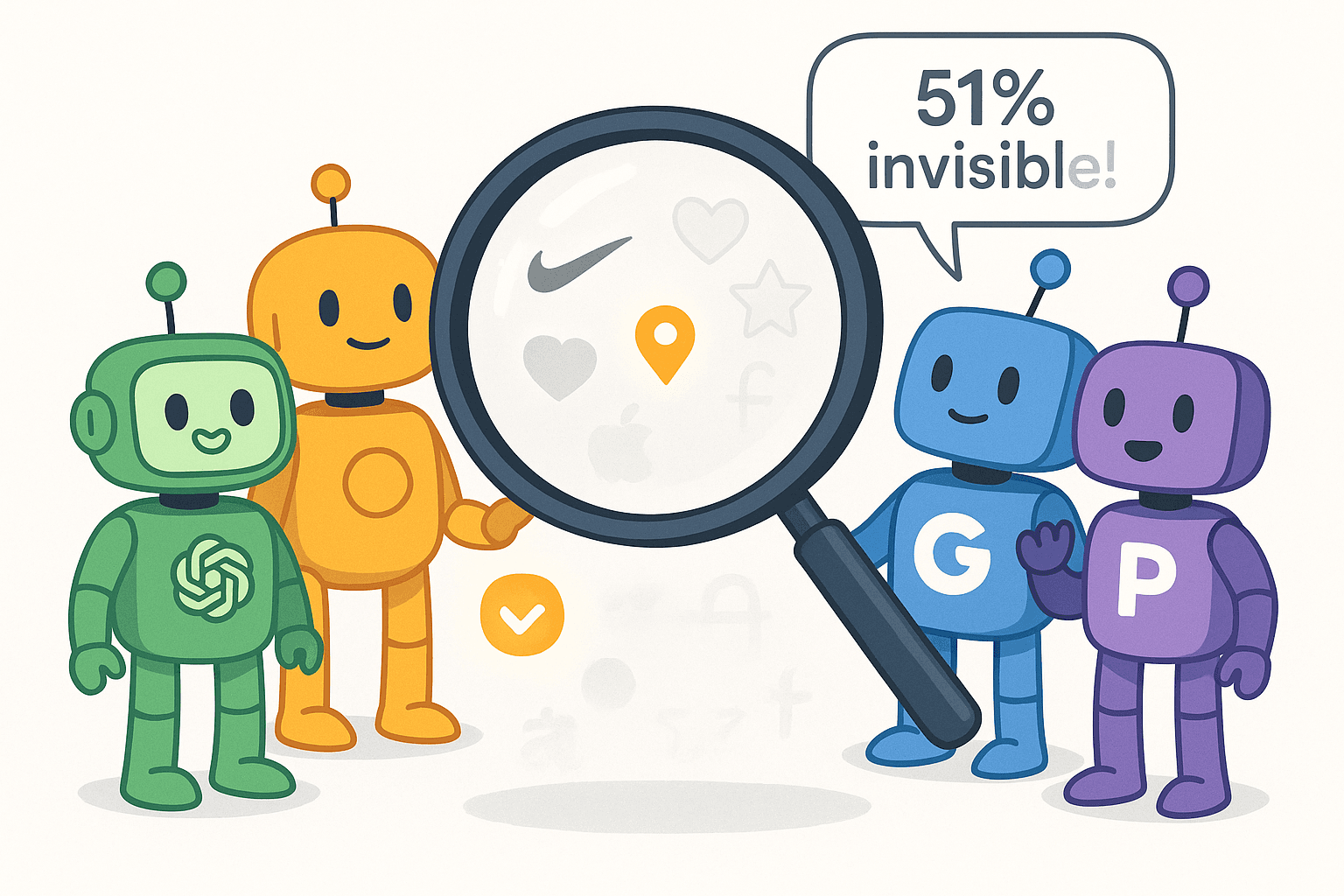
The Shocking State of AI Brand Visibility
Our analysis of 1,821 brands reveals a crisis hiding in plain sight
The Shocking Truth: 51.3% of Brands Are Completely Invisible to AI
Distribution of AI brand visibility scores across 1,821 analyzed brands
What Is an AI Brand Audit?
Beyond traditional SEO: Understanding your presence in the age of AI search
An AI brand audit is a comprehensive analysis of how artificial intelligence engines perceive, mention, and recommend your brand. Unlike traditional SEO audits that focus on search engine rankings, AI brand audits reveal your position in the new landscape where AI is becoming the primary interface for information discovery.
Here's what makes AI brand audits fundamentally different from traditional SEO analysis:
Traditional SEO Audit vs AI Brand Audit
📈 Traditional SEO Audit
- • Keyword rankings on Google
- • Backlink profiles and domain authority
- • Technical website performance
- • SERP feature appearances
🤖 AI Brand Audit
- • Brand mentions across AI responses
- • Recommendation context and sentiment
- • Primary vs alternative positioning
- • Cross-engine consistency analysis
The stakes are higher than you might think. As our engine comparison analysis reveals, each AI platform has different preferences and biases that can significantly impact your brand's visibility.
The AI Engine Divide: Not All Engines Are Created Equal
Discovery rates vary dramatically across ChatGPT, Claude, Gemini, and Perplexity
AI Engine Brand Discovery Rates: Gemini Leads at 41.7%
Percentage of brands discovered by each AI engine (out of 199 tested brands)
Gemini leads the pack with a 41.7% brand discovery rate, making it nearly twice as likely to mention your brand compared to ChatGPT (22.1%). This disparity creates what we call the "Split Personality Problem" — your brand might be famous on one engine and invisible on another.
🔍 Why Engine Differences Matter
- Gemini (41.7%): High discovery rate but lower primary recommendation percentage
- Perplexity (34.2%): Strong at finding brands but often positions them as alternatives
- Claude (27.1%): Conservative but balanced approach to brand mentions
- ChatGPT (22.1%): Lower discovery but highest quality recommendations when found
The Alternative Trap: Why Being Mentioned Isn't Enough
51% of AI brand mentions position you as a secondary choice
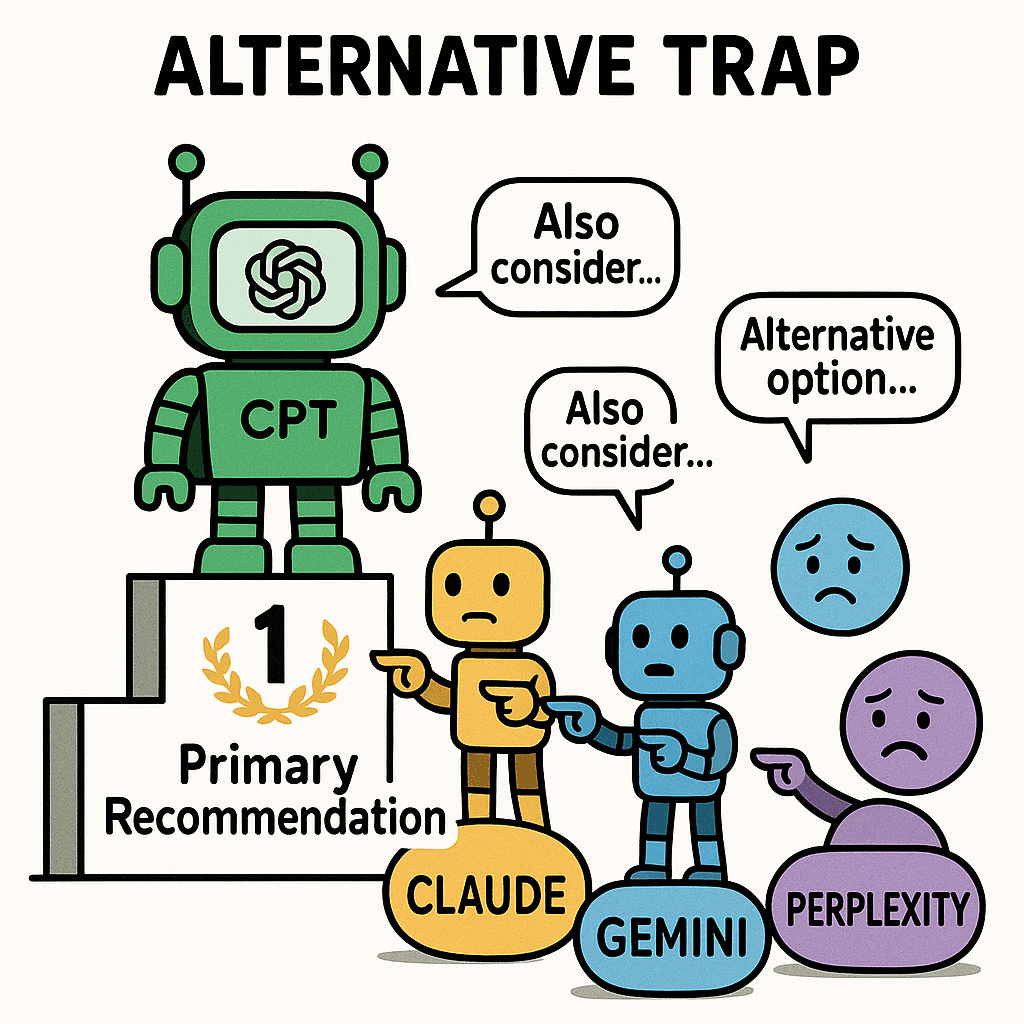
The Alternative Trap: 51% of AI Mentions Are Secondary Recommendations
Distribution of brand mention types across all AI engine responses
Getting mentioned by AI engines isn't enough — it's about how you're mentioned. Our analysis reveals that 51% of all brand mentions are "alternative" recommendations, meaning brands are fighting for second place in AI responses.
"For project management, I'd recommend Asana. You might also consider Monday.com, Trello, or Notion as alternatives."
In this response, only Asana gets primary positioning, while three other brands are relegated to alternative status.
This positioning matters enormously for user behavior. Research from Spiceworks shows that users are 3.2x more likely to choose the primary AI recommendation over alternatives.
ChatGPT Champions Brands: The Primary Recommendation Leader
While ChatGPT finds fewer brands, it treats them better when it does
ChatGPT Champions Brands: 43.2% Primary Recommendation Rate
Primary vs Alternative recommendation rates by AI engine
Despite having the lowest discovery rate, ChatGPT leads in primary recommendation quality with 43.2% of mentions being primary recommendations. This creates an interesting strategic dilemma: Would you rather be mentioned frequently as an alternative, or less frequently as a primary choice?
✅ High Primary Rate Engines
- ChatGPT: 43.2% primary rate
- Gemini: 28.9% primary rate
Better at positioning brands as top choices when mentioned.
⚠️ Alternative-Heavy Engines
- Claude: 24.1% primary rate
- Perplexity: 20.6% primary rate
More likely to position brands as secondary options.
The implication? Optimizing for ChatGPT's primary recommendations might deliver better conversion rates than chasing high mention volumes on other engines.
How to Check Your AI Brand Visibility (Step-by-Step)
Your complete guide to conducting a professional AI brand audit
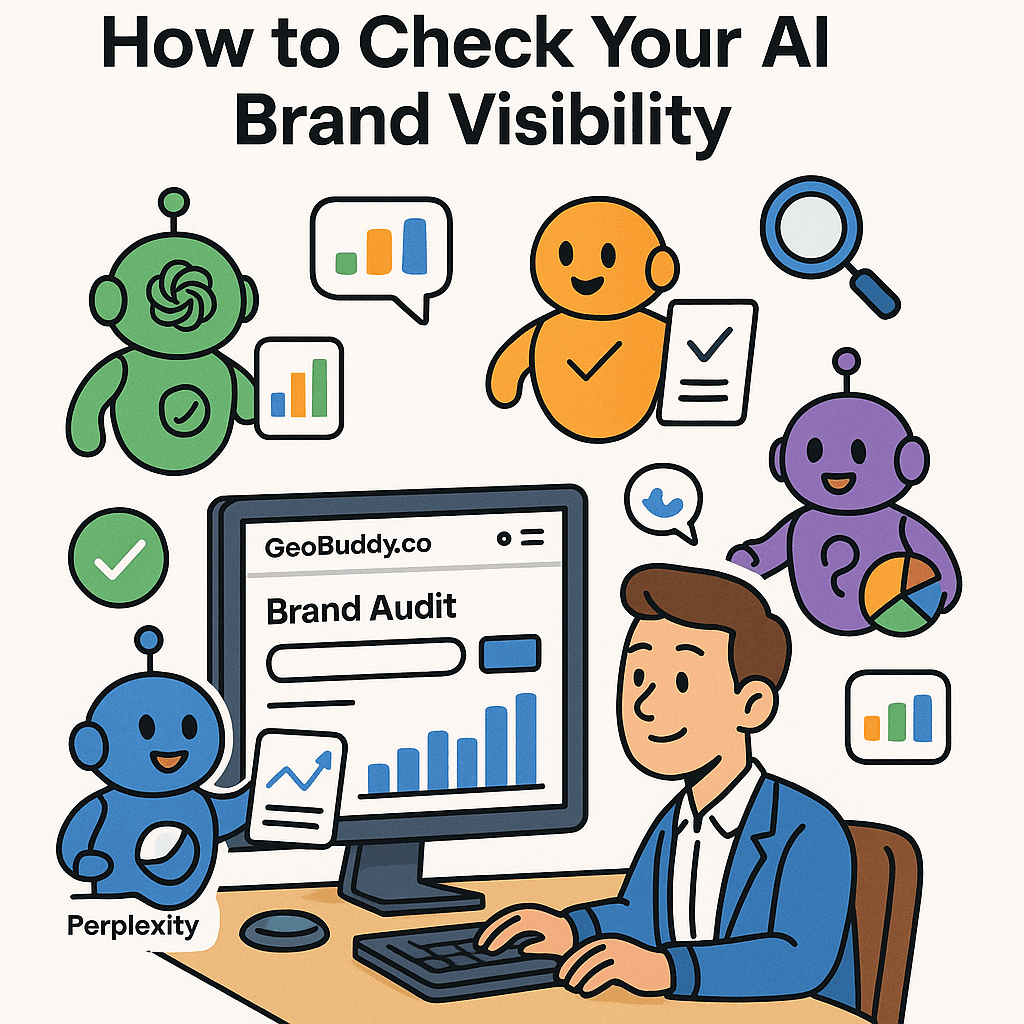
🔄 Method 1: Free Automated Check (Recommended)
The fastest way to audit your brand is using our comprehensive tool:
- Visit GeoBuddy's Free Brand Checker
Go to geobuddy.co/check and enter your brand name - Select Your Industry
Choose your industry category for contextually relevant prompts - Get Your Comprehensive Report
Receive visibility scores, sentiment analysis, and competitive positioning across all four engines
🛠️ Method 2: Manual DIY Audit
For a basic understanding, you can manually test your brand:
Sample Prompts to Test:
- • "What are the best [your industry] tools?"
- • "I need a solution for [your use case], what do you recommend?"
- • "Compare the top [your category] options available in 2026"
- • "Which [your industry] companies should I consider?"
- Test each prompt on ChatGPT, Claude, Gemini, and Perplexity
- Record whether your brand is mentioned and in what context
- Note your ranking position and sentiment
- Track which competitors are mentioned alongside you
📊 What to Look For in Your Results
🚩 Red Flags
- • 0% visibility across engines
- • Only alternative mentions
- • Negative sentiment scores
- • Inconsistent positioning
✅ Green Lights
- • Primary recommendations
- • Positive sentiment (0.6+)
- • Consistent cross-engine mentions
- • High-ranking positions
Industry AI Visibility Gaps: Where Does Your Sector Stand?
Language learning leads while project management struggles
Industry AI Visibility Gap: Language Learning Leads at 24.1%
Average brand visibility score by industry (minimum 20 brands analyzed)
Industry matters significantly for AI visibility. Our analysis of brands with sufficient sample sizes reveals stark differences between sectors. Language Learning brands average 24.1% visibility, while Project Management tools struggle at just 12.5%.
🏆 Industry Leaders
- Language Learning (24.1%): Benefits from clear use cases and emotional user stories
- Property Management Software (20.4%): Specific industry terms help AI recognition
- SEO Tools (16.4%): Ironic that SEO tools struggle with AI visibility
- Project Management (12.5%): Crowded market makes differentiation difficult
The industry gap suggests that category clarity and use case specificity play crucial roles in AI recognition. Brands in well-defined niches with clear problems tend to perform better than those in crowded, commoditized markets.
The 100% Club: Lessons from Perfect-Score Brands
What Nike, Zoom, and 16 other brands get right about AI visibility
The 100% Club: What Perfect-Score Brands Have in Common
Top 5 brands with 100% AI visibility across all engines
Only 18 brands (1% of all analyzed) achieve 100% visibility across all AI engines. Our detailed analysis of the 100% Club reveals several common characteristics:
🏢 Market Position
- • Category leaders or pioneers
- • Strong brand recognition
- • Clear value propositions
📊 Content Strategy
- • High-quality authoritative content
- • Strong domain authority
- • Consistent brand messaging
💬 User Sentiment
- • Positive customer reviews
- • Strong community presence
- • Word-of-mouth advocacy
The Split Personality Problem: When Engines Disagree
Some brands score 100% on one engine and 0% on another
The Split Personality Problem: Brand Consistency Across AI Engines
Some brands score 100% on one engine but 0% on another
One of the most fascinating findings in our AI brand audit research is the dramatic inconsistency between engines. We've identified brands that achieve 100% visibility on Gemini while remaining completely invisible on ChatGPT, and vice versa.
🔴 Extreme Split Examples
Real brands from our database:
- • Brand A: 88% on Gemini, 12% on ChatGPT
- • Brand B: 75% on Claude, 8% on Perplexity
- • Brand C: 92% on ChatGPT, 31% on Claude
This inconsistency creates strategic challenges for brands. Do you optimize for the engine that loves you, or focus on fixing the engines where you're invisible? Our recommendation: aim for consistency first, then amplify your strengths.
The root causes of these splits often trace back to different training data sources, algorithmic preferences, and inherent model biases that vary between AI systems.
The Growing Urgency: Why AI Brand Audits Matter More Than Ever
As AI adoption accelerates, brand visibility becomes mission-critical
AI Brand Audit Adoption: Growing Awareness, Still Shocking Results
Monthly growth in brands checking their AI visibility (simulated timeline)
AI brand auditing is moving from "nice-to-have" to business-critical. Pew Research data shows that 58% of professionals now use AI tools weekly, making AI engines a primary discovery channel for brands.
📈 Why This Matters Now
- •User Behavior Shift: AI-powered search is becoming the default
- •Competitive Advantage: Early movers gain positioning before markets saturate
- •Training Data Windows: Today's content influences future AI knowledge
⚠️ The Cost of Waiting
- •Competitors establish AI mindshare while you're invisible
- •Negative brand associations become harder to correct
- •Missing the window of AI algorithm influence
What Makes Brands Visible to AI: The Success Factors
Common patterns among high-visibility brands reveal the AI visibility formula
After analyzing 1,821 brands and their AI performance, clear patterns emerge among those that achieve high visibility. Social media presence doesn't correlate with AI visibility, but these factors do:
✅ High-Impact Factors
🏆 Category Leadership
Being first or dominant in your niche creates strong AI association patterns.
📚 Authoritative Content
High-quality, well-cited content that other sites reference and link to.
🔗 Strong Domain Authority
Established domains with quality backlinks from trusted sources.
❌ Low-Impact Factors
📱 Social Media Followers
Instagram/Twitter following shows no correlation with AI mentions.
💰 Advertising Spend
Paid ads don't directly influence AI training data or recommendations.
📊 Recent SEO Rankings
Current Google rankings don't predict AI visibility due to training data lag.
🎯 The AI Visibility Formula
Based on our analysis, the brands that achieve consistent AI visibility follow this pattern:
- Authority: Trust signals from citations, backlinks, and expert mentions
- Consistency: Unified brand messaging across all digital touchpoints
- Category Clarity: Clear problem-solution fit that AI can understand
Your 30-Day AI Brand Visibility Action Plan
Immediate steps to improve your AI brand audit results
Week 1: Audit & Baseline
- • Run comprehensive AI brand audit
- • Document current visibility scores
- • Analyze competitor positioning
- • Identify visibility gaps
Week 2-3: Content Optimization
- • Strengthen category association content
- • Improve domain authority signals
- • Create use-case specific pages
- • Update brand messaging consistency
Week 4: Monitor & Adjust
- • Re-run AI brand audit
- • Compare before/after scores
- • Double-down on what's working
- • Plan next optimization cycle
Don't Let Your Brand Disappear in the AI Revolution
Join the 1,821+ brands that have discovered their AI visibility score. Get your comprehensive audit in under 60 seconds.
Related AI Brand Research
Dive deeper into the data behind AI brand visibility
The Alternative Trap
Why AI mentions don't mean recommendations
The 100% Club
What perfect-score brands have in common
Engine Comparison
ChatGPT vs Claude vs Gemini vs Perplexity
SEO Tools Leaderboard
Most invisible brands to AI
ChatGPT Optimization
How to get recommended by ChatGPT
AI Citation Tracking
Monitor brand mentions across AI engines
📖 Reading time: 12 minutes | ✍️ Research by GeoBuddy Team | 📅 Published March 23, 2026
Data sources: 1,821 brand analyses across ChatGPT, Claude, Gemini, and Perplexity | Last updated: March 23, 2026