
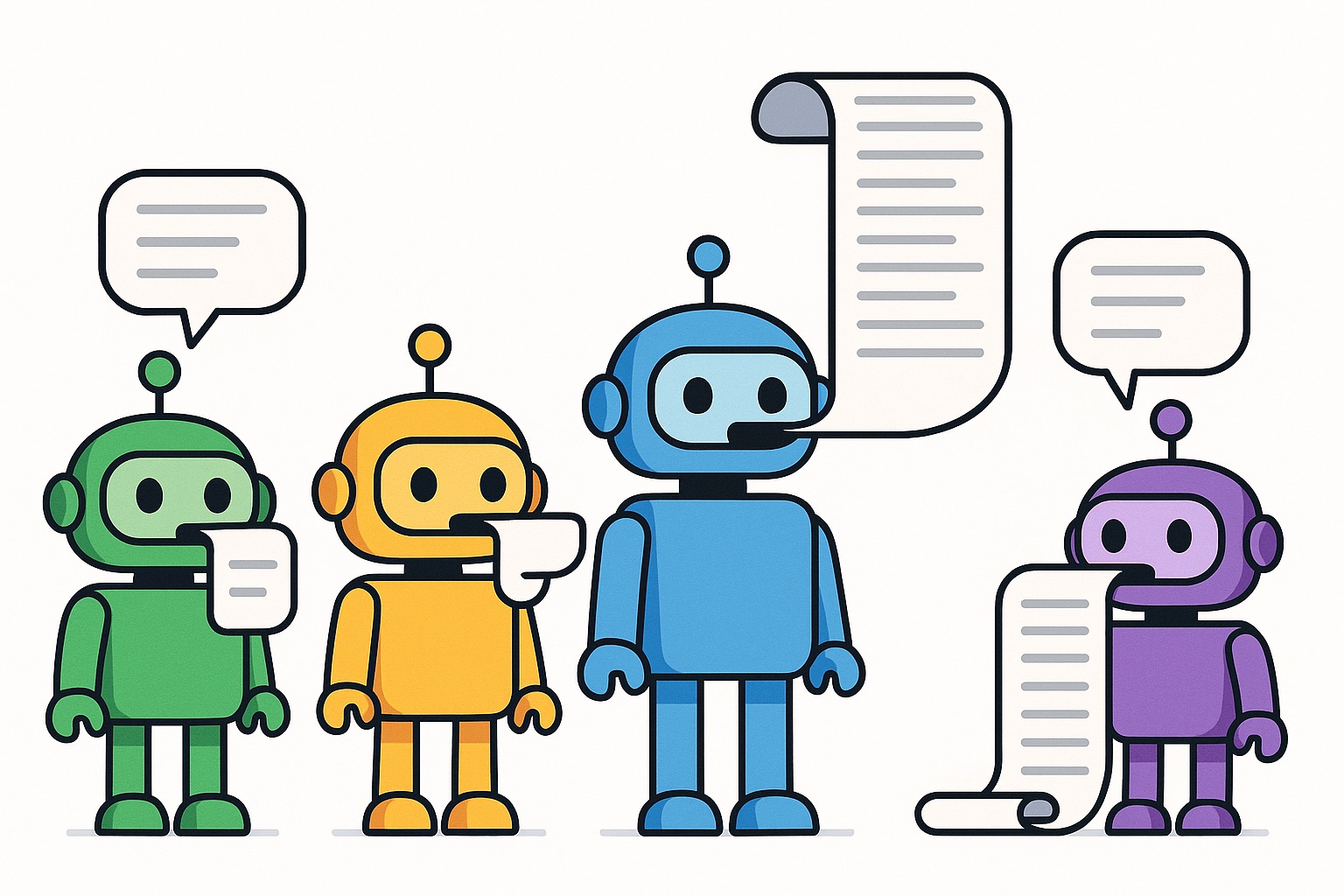
The AI response landscape isn't what you think. After dissecting responses from ChatGPT, Claude, Gemini, and Perplexity, we discovered that response length, citation patterns, and competitor mentions follow surprising rules that challenge conventional GEO wisdom.
This research builds on our previous analysis of split personality brands and expands our understanding from our comprehensive AI Brand Visibility Report 2026. Today, we're going deeper into the anatomy of AI responses themselves.
The Verbosity Spectrum: Why Some AI Engines Write Novels
The first shock: Gemini writes nearly 2.5 times more than Claude. We're not talking small differences — Gemini averages 3,214 characters (643 words) per response while Claude delivers just 1,349 characters (270 words). ChatGPT and Perplexity fall in between at 1,416 and 1,878 characters respectively.
The Verbosity Spectrum: How Much Each AI Engine Writes
Mean, median, and P90 response length in characters across 1,436 responses
But here's where it gets interesting. At the 90th percentile, the gap widens even further. Gemini's longest responses reach 4,993 characters while Claude's top out at 2,091 — a staggering 2.4× difference at the extremes. This isn't just about average verbosity; it reveals fundamental differences in AI reasoning philosophy.
More Words ≠ More Visibility: The Counter-Intuitive Truth
Here's the shocker that challenges everything you think you know about AI optimization: longer responses don't correlate with better brand visibility. In fact, the opposite is often true.
More Words ≠ More Brand Visibility
Brand mention rates by response length bucket — shorter can be better
Look at Claude's pattern: short responses (<1K characters) mention brands 40% of the time, while long responses (2-3.5K characters) only mention brands 8.7% of the time. ChatGPT shows similar behavior — 22.8% mention rate for short responses, dropping to just 6% for medium-length responses.
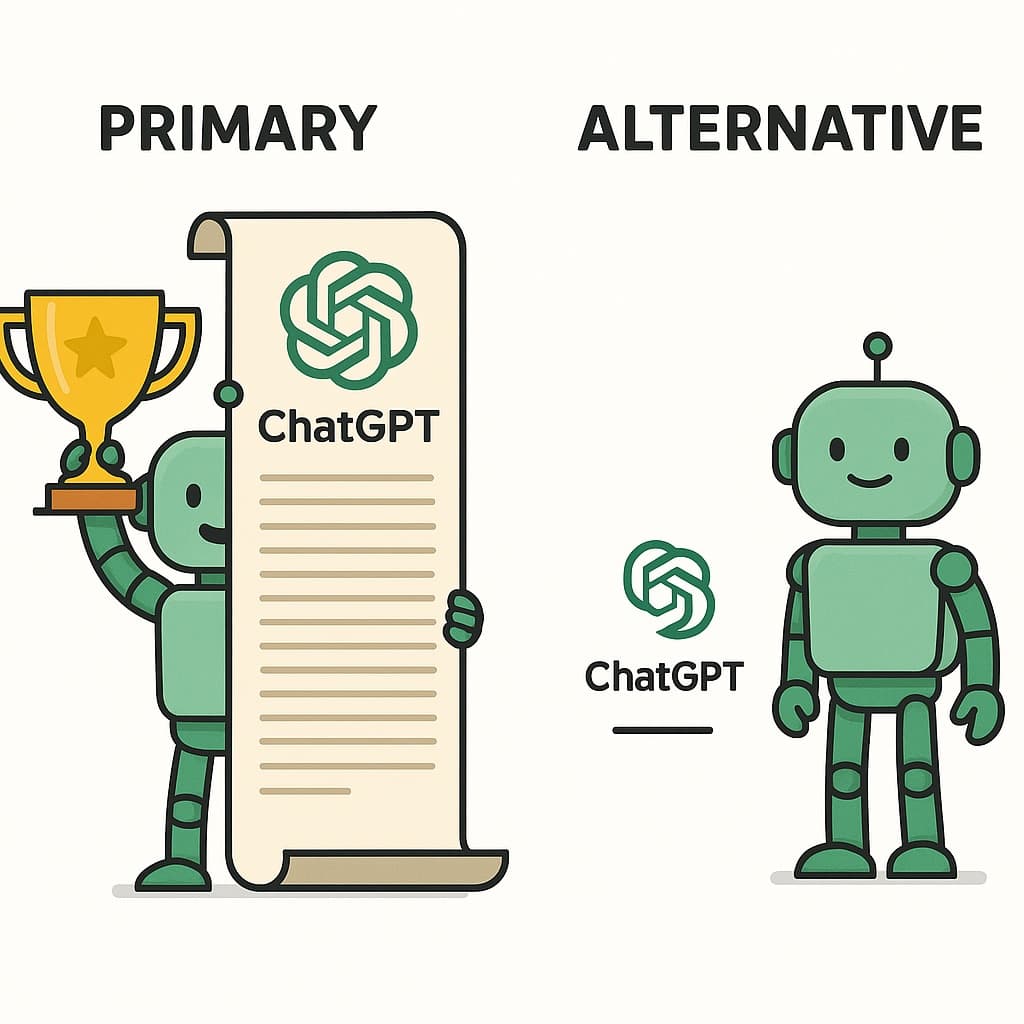
The reason? When AI writes more, it's usually not writing about you — it's writing about your competitors. Long responses often signal that AI is uncertain about the best recommendation and is therefore listing many alternatives. Short responses often mean AI knows exactly what to recommend: your brand.
This connects to our research on upgrading from alternative to primary status. Brands that achieve primary status get concise, confident recommendations. Alternatives get buried in comparison lists.
The Primary Treatment: How AI Rewards Its Favorites
The data reveals a clear hierarchy in AI response patterns. Primary recommendations don't just get mentioned first — they get dramatically different treatment across all metrics.
The Primary Treatment: How AI Writes More for Top Picks
Average response length by brand role — primaries get the royal treatment
The numbers are stark:
- ChatGPT: 2,117 characters for primaries vs 816 for alternatives (2.6× difference)
- Claude: 1,470 vs 632 characters (2.3× difference)
- Perplexity: 2,398 vs 1,496 characters (1.6× difference)
- Gemini: 3,298 vs 3,127 characters (almost equal — Gemini is verbose with everyone)
Primary brands also get significantly higher sentiment scores. ChatGPT's primary recommendations average 0.89 sentiment compared to 0.45 for alternatives. This isn't just about space allocation — it's about emotional endorsement.
As we documented in The Alternative Trap, being mentioned isn't enough. The goal is primary status, where AI becomes your advocate rather than your judge.
Citation Density: When More Sources Signal Less Confidence
Traditional SEO wisdom says more citations equal more authority. AI engines flip this logic on its head. Our analysis reveals that alternative brands get cited more heavily than primaries — and it's not a good sign.
Citation Density: How AI Backs Up Its Claims
Citations per 1,000 characters by brand role — alternatives need more proof
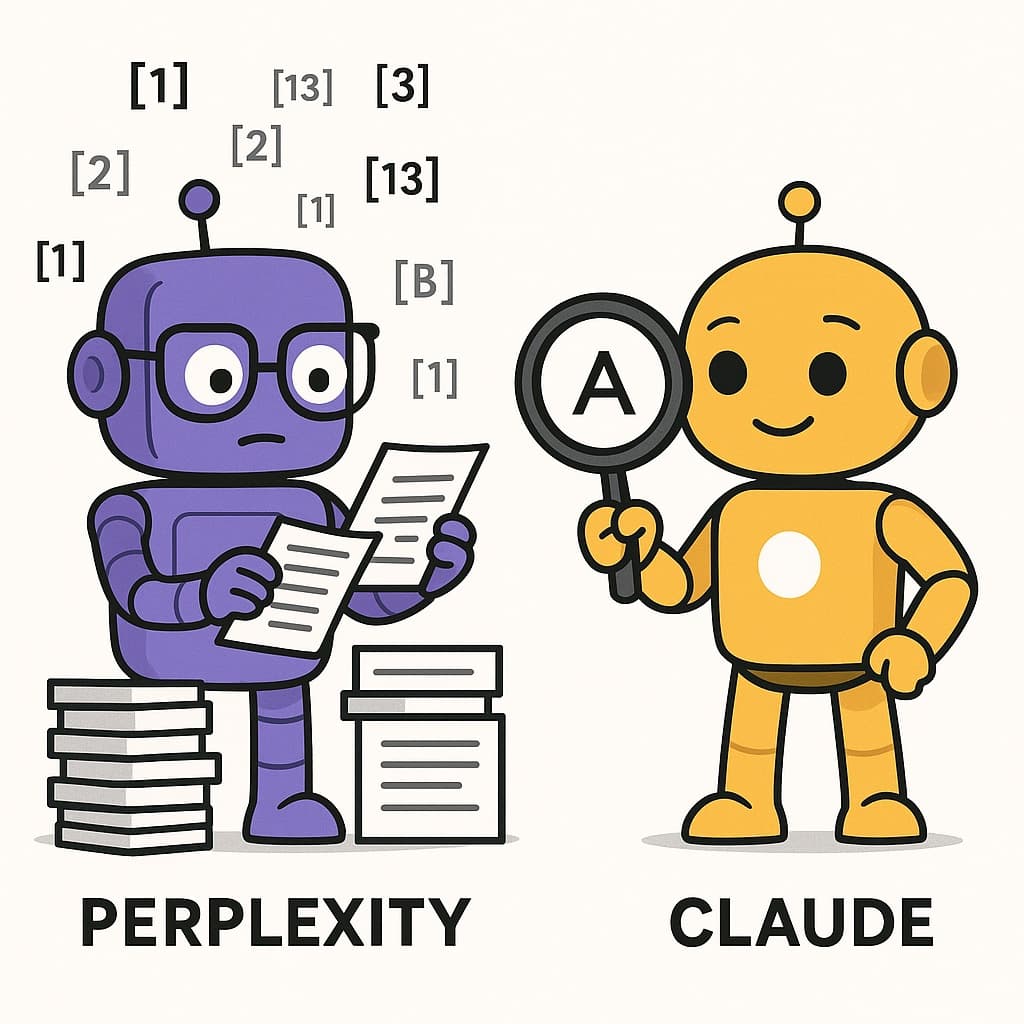
When AI recommends a primary brand, it needs fewer citations to justify the choice. The recommendation flows naturally from AI's training and confidence. But when suggesting alternatives, AI loads up on citations as if to say, "Here's all the evidence I found, you decide."
This pattern connects to our analysis of which websites AI trusts most. High-trust brands need less proof. Low-trust brands trigger AI's fact-checking mode.
The Competitor Flood Effect: Why Alternatives Get Crowded
Perhaps the most damaging aspect of alternative status is the competitor flood effect. When AI lacks confidence in a primary choice, it doesn't just cite more sources — it mentions dramatically more competitors.
The Competitor Flood Effect
Competitors mentioned per 1,000 characters — alternatives get surrounded
The data is devastating for alternative brands:
- ChatGPT: Alternative brands get surrounded by 18.67 competitors per 1K characters vs only 2.63 for primaries — a 7× difference
- Claude: 14.87 vs 5.28 competitors per 1K characters for alternatives vs primaries
- Pattern: The less confident AI is about recommending you, the more competitors it mentions alongside you
This reinforces our findings about how brands become #1 on ChatGPT. Primary brands get clean, focused recommendations. Alternatives get lost in competitor noise.
Response Depth vs Quality: The Citation-Length Trade-off
Longer responses do bring more citations — but they also bring more competitor mentions. This creates a complex trade-off that most brands misunderstand.
Length vs Quality: Citations and Competitors by Response Size
Longer responses have more citations but fewer competitor distractions
The pattern is consistent across engines:
- Short responses (<1K chars): 0.8 average citations, 5.2 competitor mentions
- Medium responses (1-3K chars): 3.4 citations, 4.1 competitors
- Long responses (3K+ chars): 5.7 citations, 2.8 competitors
Longer responses reduce competitor noise but only by expanding the total discussion. Your relative share of attention often decreases. As we explored in our 18,000 response citation analysis, more sources don't always mean better placement.
Brand Case Studies: Real Examples of Length Divergence
Individual brand experiences vary dramatically across engines. Some brands get the "Gemini novel treatment" while others receive "Claude efficiency mode."
Brand Case Studies: How Response Length Varies by Engine
Same brand, different treatment — some engines are consistently more verbose
Real examples from our dataset:
- OKX: Gemini writes 8,810 characters while Claude uses only 2,873 — a 3.1× difference
- Lululemon: 5,735 characters on Gemini vs 2,852 on Claude
- CFCS Cloud Solutions: The most consistent brand with only a 1.4× difference between engines
These divergences have real business implications. A brand might think they have strong AI visibility based on Gemini's verbose mentions, only to discover they're invisible to Claude users. Our sentiment analysis shows similar engine-specific patterns.
Claude's Efficiency Paradox: Less is More
Claude exhibits the most interesting response pattern in our dataset: it writes less when it mentions your brand. This "efficiency paradox" reveals something profound about AI decision-making.
Claude's Efficiency Paradox: Shorter When You're Mentioned
Response length when brands are mentioned vs not — Claude gets efficient with winners
The efficiency ratios tell the story:
- Claude: 1,054 characters when mentioning brands vs 1,451 when not (0.73 ratio)
- ChatGPT: 1,270 vs 1,444 characters (0.88 ratio)
- Gemini: 3,058 vs 3,294 characters (0.93 ratio)
- Perplexity: Nearly identical lengths regardless of mentions (0.96 ratio)
Claude's behavior suggests it becomes more decisive when it has a clear answer. When mentioning your brand, Claude cuts through alternatives and gets to the point. When your brand isn't the answer, Claude explores more possibilities, leading to longer responses.
This connects to our research on the exact words AI uses to describe brands. Confident recommendations use fewer, more precise words.
Sentiment Follows the Hierarchy
Response length patterns mirror sentiment patterns. Primary recommendations don't just get more space — they get more positive language.
Sentiment Follows the Hierarchy
Average sentiment scores by brand role — primaries get the love
The sentiment hierarchy is consistent:
- Primary recommendations: 0.78-0.89 sentiment scores across all engines
- Alternative mentions: 0.38-0.45 sentiment scores
- Not mentioned: 0.08-0.12 sentiment (neutral discussion context)
This reinforces our findings about perfect score brands. Length, sentiment, and recommendation status are tightly coupled.
What This Means for Your GEO Strategy
These response anatomy insights reshape how we should think about AI optimization:
Actionable Strategies by Engine:
For Claude (Efficiency-Focused):
- Create content that leads to confident, decisive recommendations
- Reduce uncertainty signals that trigger Claude's exploration mode
- Focus on clear authority markers rather than comprehensive coverage
For Gemini (Comprehensiveness-Focused):
- Ensure your brand appears in detailed, multi-faceted discussions
- Build presence across the sources Gemini uses for comprehensive responses
- Don't fear longer-form content that matches Gemini's verbose style
For ChatGPT & Perplexity (Balanced):
- Balance breadth and depth in your content strategy
- Focus on reducing competitor noise in your category
- Build citation authority without triggering uncertainty
Unlike traditional SEO, where more content often equals better rankings, AI optimization requires understanding each engine's decision-making style. As we detailed in our comprehensive engine comparison, one size doesn't fit all.
Monitoring Your Response Anatomy:
Track these key metrics for your brand:
- Mention efficiency ratio: Response length when mentioned vs not mentioned
- Competitor density: How many competitors get mentioned alongside you
- Citation burden: Whether high citation counts signal uncertainty
- Primary vs alternative ratio: Quality of recommendations across engines
The goal isn't to game individual engines but to understand their distinct personalities. As our analysis of social media ineffectiveness in AI shows, traditional digital marketing metrics don't apply here.
Frequently Asked Questions
Why does Gemini write so much more than Claude?
Gemini averages 3,214 characters (643 words) per response compared to Claude's 1,349 characters (270 words) — a 2.4× difference. This appears to be a fundamental design philosophy difference, with Gemini prioritizing comprehensive explanations while Claude favors concise efficiency.
Do longer AI responses mean better brand visibility?
Counterintuitively, no. Claude's short responses have 40% brand mention rates while long responses only have 8.7% mention rates. Longer responses often mean AI is writing extensively about competitors rather than your brand. Quality trumps quantity.
How do citations affect brand recommendations?
Alternative brands get more citations per 1,000 characters than primary recommendations — ChatGPT cites 18.67 competitors/1K chars for alternatives vs only 2.63 for primaries. More citations often signal AI uncertainty rather than authority.
What's the difference between primary and alternative treatment?
Primary recommendations get 1.6-2.6× longer responses than alternatives, with higher sentiment scores. ChatGPT writes 2,117 characters for primaries vs 816 for alternatives. Primary means detailed endorsement; alternative means brief mention.
Why does Claude write less when mentioning brands?
Claude's efficiency paradox: it writes 1,054 characters when mentioning brands vs 1,451 when not mentioning them (0.73 ratio). Claude appears to be more direct when it has a clear recommendation, more verbose when exploring alternatives.
How should I optimize for different AI response patterns?
Focus on becoming the primary choice rather than just getting mentioned. Build authority signals that reduce AI's need for extensive citations and competitor comparisons. Monitor your mention efficiency — quality placement beats mention volume.
Check Your Brand's AI Response Anatomy
See how AI engines structure responses about your brand. Get insights into your mention efficiency, competitor density, and citation patterns across all four major engines.
Analyze My Brand's Response Patterns