
**Gemini cites 14x more sources than ChatGPT.** When we analyzed 86,000+ citations across 1,924 brands, this was the most shocking discovery. But it gets weirder: only 16 domains are trusted by ALL four AI engines. Your Instagram strategy won't help your AI visibility. And YouTube is the #1 cited domain—but only for some engines.
This is the first comprehensive analysis of what websites AI engines actually cite when making brand recommendations. We parsed every citation from 86,000+ AI responses to understand which domains have earned AI trust—and which haven't.
Why this matters: AI engines don't just make up their answers. They cite specific sources to support their recommendations. Understanding which domains have earned AI trust is the key to improving your brand's AI visibility. Get mentioned by these trusted sources, and AI engines will cite you too.
Citation Volume by AI Engine
Total citations and unique domains across 86,000+ citations
Gemini Is the Citation King (ChatGPT Is Stingy)
**Gemini generated 39,000 citations. ChatGPT generated 2,800.** This 14x difference reveals fundamentally different approaches to sourcing information. Gemini is generous with citations—almost scholarly in its thoroughness. ChatGPT is selective, citing only the sources it deems most essential.
But volume isn't everything. ChatGPT's 2,800 citations span just 1,350 unique domains, meaning it repeatedly cites the same trusted sources (2.07 citations per domain). Gemini's 39,000 citations span 23,500 domains—a much more diverse citation portfolio (1.66 citations per domain).
**The business implication:** Getting cited by ChatGPT is harder but more valuable—it only trusts a small circle of domains. Getting cited by Gemini is more accessible but requires standing out in a crowded field of 23,500 potential sources. Different engines, different strategies needed.
Top 10 Most Cited Domains
Green bars = trusted by all 4 AI engines
YouTube Dominates (But Not Everywhere)
**YouTube.com received 3,360 citations—more than any other domain.** But here's the twist: ChatGPT and Claude barely cite YouTube at all. 63% of YouTube citations come from Perplexity alone, with Gemini contributing most of the rest.
This reveals something crucial about engine personalities. Perplexity treats YouTube as a legitimate information source—probably because it uses real-time web search and finds fresh YouTube content. ChatGPT and Claude, relying more on training data, don't see YouTube the same way.
The pattern repeats with other domains. Zapier.com(1,280 citations) and G2.com (680 citations) get love from three engines but are ignored by ChatGPT. Meanwhile,NerdWallet.com (630 citations) and TechRadar.com (460 citations) have achieved the rare feat of being trusted by all four engines.
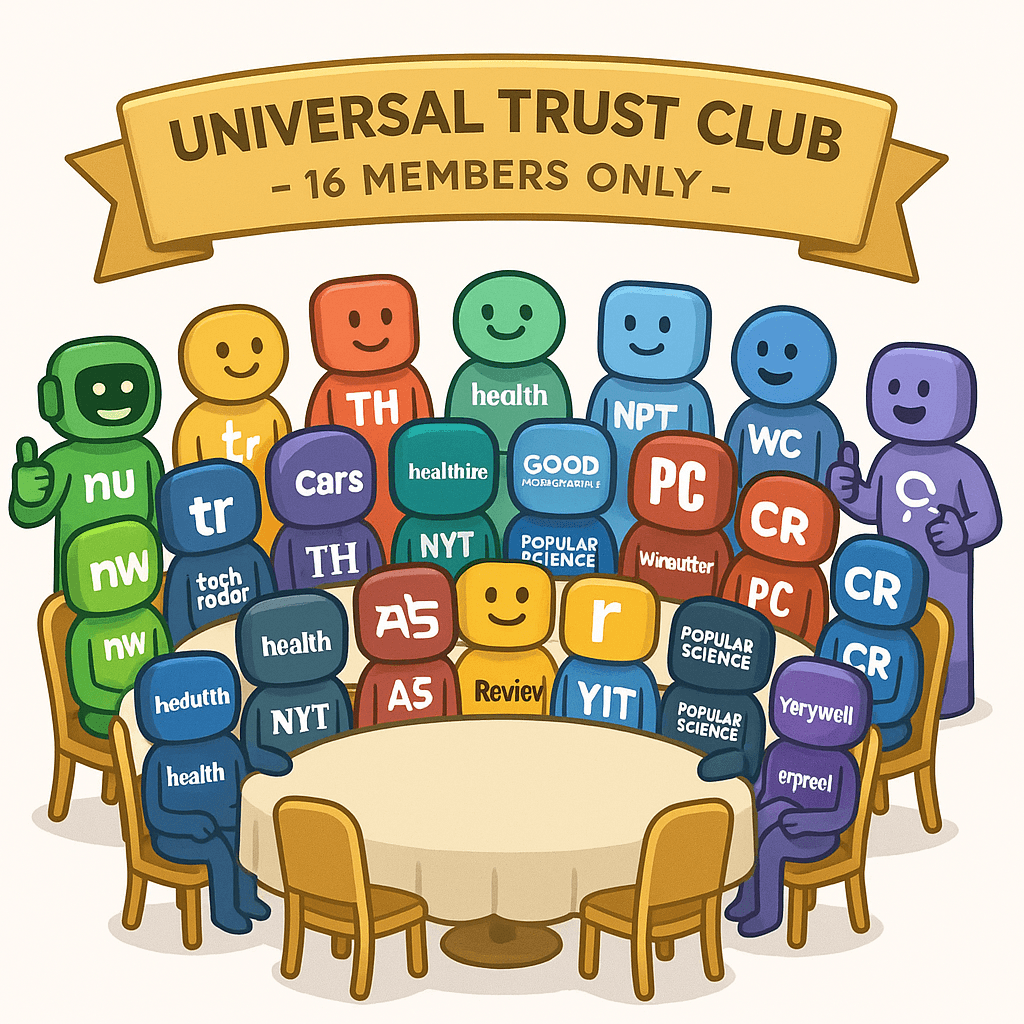
The Universal Trust Club: Only 16 Members
**Out of 24,600+ domains, only 16 are cited by all four AI engines.** This is the most exclusive club on the internet—the Universal Trust Club. These domains have achieved something remarkable: they've earned the trust of ChatGPT's selectivity, Claude's caution, Gemini's diversity, and Perplexity's real-time focus.
The Complete Universal Trust Club (16 domains):
- nerdwallet.com
- techradar.com
- semrush.com
- ulta.com
- healthline.com
- sustainabilitymag.com
- money.com
- mayoclinic.org
- learn.g2.com
- rogueenergy.com
- apps.apple.com
- jotform.com
- bevsource.com
- pipedrive.com
- revenue.io
- tomsguide.com
What do these domains have in common? They span multiple categories (finance reviews, tech media, health, SaaS tools) but share key traits: authoritative content, structured information, regular updates, and domain authority. They've optimized not for one AI engine, but for the fundamental qualities that all AI engines value: trustworthy, well-structured, frequently-updated content.
If you want universal AI trust, study these 16 domains. See our detailed analysis inThe AI Brand Visibility Report 2026 for what makes them special.
The Universal Trust Club
Only 16 domains are cited by ALL 4 AI engines (out of 24,600+ domains)
Each Engine Has a Citation Personality
**ChatGPT cites Google properties for 65% of its citations.** Wikipedia accounts for 71% of all Wikipedia citations across the four engines. ChatGPT has a clear family bias—it trusts the Google ecosystem and established reference sources above all else.
**Gemini owns Reddit.** 98% of Reddit citations come from Gemini alone (540 out of 550 total). While other engines ignore Reddit entirely, Gemini sees it as a valuable source of real human opinions and discussions. This aligns with Gemini's preference for diverse, conversational content.
**Perplexity is YouTube-obsessed.** 63% of YouTube citations come from Perplexity. Its real-time web search finds fresh YouTube content that other engines miss. Perplexity treats video content as legitimate information—a unique perspective in the AI landscape.
**Claude prefers review sites and authority content.** It consistently cites domains likeG2,NerdWallet, and industry analysis sites. Claude wants third-party validation and structured reviews, not just brand-generated content.
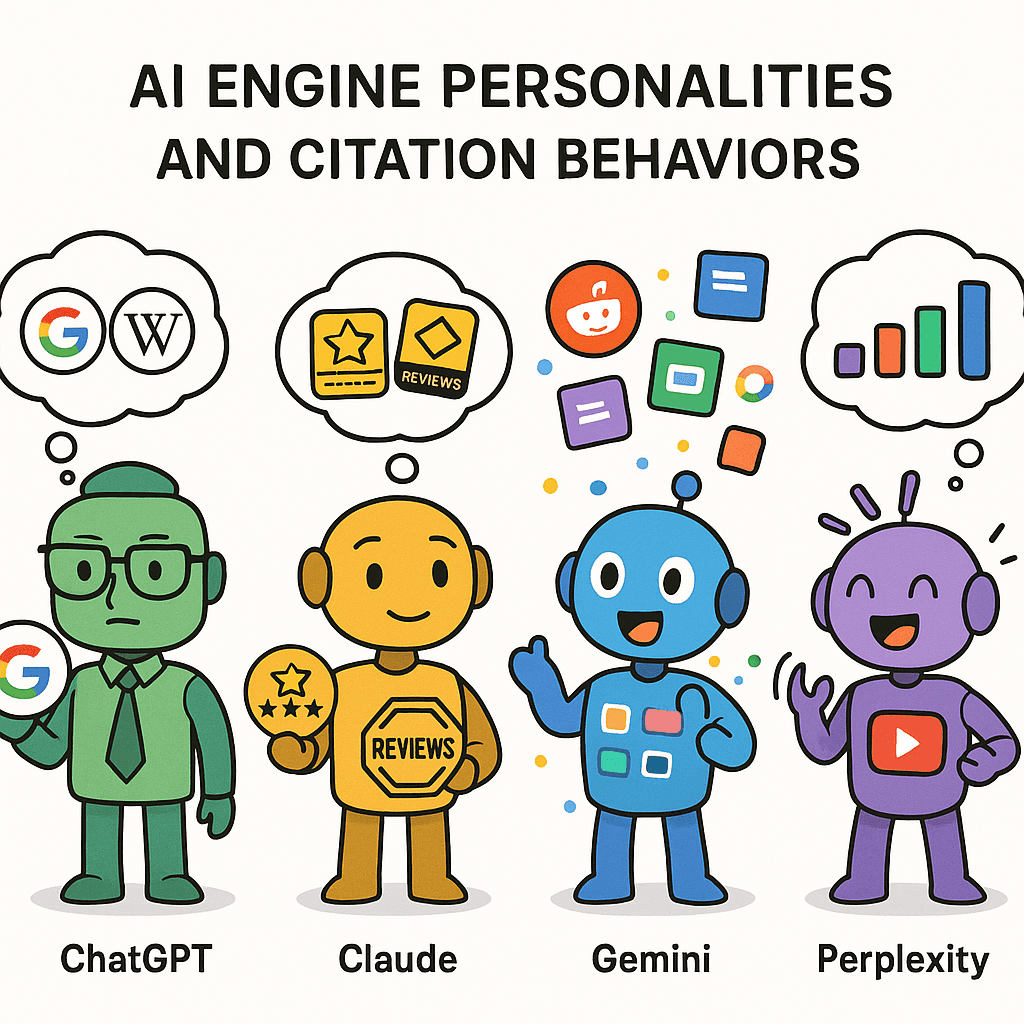
AI Engine Citation Personalities
Each engine has distinct preferences (scale: 0-100)
Social Media Is Invisible to AI
**Instagram: 0 citations. Twitter: 0 citations. TikTok: 0 citations. Facebook: 0 citations.** If you're spending marketing budget on social media for AI visibility, you're wasting your money.
The reason is structural, not personal. These platforms are built for ephemeral, visual, or private content. AI engines need persistent, text-based, publicly accessible information to cite. Your Instagram post might get 100,000 likes, but ChatGPT will never cite it in a recommendation.
The two exceptions prove the rule: YouTube (3,360 citations) succeeds because it has rich metadata, transcripts, and persistent URLs. Reddit (550 citations) works because discussions are text-based and public. Both platforms store information in ways AI engines can parse and reference.
The costly mistake: Brands spend millions on Instagram influencers and Twitter campaigns thinking it builds "online authority." For AI visibility, this authority is invisible. Focus on platforms and content formats that AI engines can actually cite. Learn which content formats work best in ourguide to getting cited by AI engines.
Social Media Citation Reality Check
Why your Instagram strategy won't help AI visibility
Key Insight:
Traditional social media platforms get virtually zero AI citations. Only YouTube (with rich metadata) and Reddit (public discussions) break through.
Category Breakdown: What Content Types Win
**SaaS/Marketing Tools dominate with 1,890 citations.** Tools likeSEMrush,Ahrefs, andMoz have built AI trust by consistently publishing data-driven content, maintaining detailed documentation, and providing structured information that AI engines love.
**Finance Reviews (1,200 citations)** succeed because they provide comparative analysis—exactly what users ask AI engines for. When someone asks "What's the best credit card?", AI engines naturally cite domains like NerdWallet and Money.com that have already done the comparison work.
**Tech Media (930 citations)** maintains relevance by covering emerging topics that match user queries. Sites like TechRadar and Tom's Guide get cited because they review the latest products and technologies that people ask AI about. Their structured reviews and buying guides align perfectly with AI recommendation formats.
The lesson? AI engines cite content that matches user intent. Comparison guides, structured reviews, data analysis, and how-to content perform best. Brand homepages and marketing fluff get ignored. See which content types work best for your industry in ourAI Engine Disagreement Analysis.
Citation Categories Breakdown
What types of content AI engines cite most
Engine Exclusivity: Why Gemini Has Its Own Universe
**Gemini cites 16,400 domains that no other engine touches.** This is the most striking finding in our analysis. While ChatGPT has just 610 exclusive domains, Gemini operates in its own universe of sources. It's finding and trusting content that Claude, ChatGPT, and Perplexity ignore entirely.
What explains this massive difference? Gemini benefits from Google's comprehensive web crawl and knowledge graph. It has access to more content and more sophisticated methods for evaluating trust and relevance. The other engines are working with more limited training data or real-time search that can't match Google's scale.
**The strategic implication:** If you want broad AI visibility, you need to think beyond the obvious authority sites. Gemini is finding value in long-tail content that other engines miss. This creates opportunities for smaller sites and niche content creators who might never crack ChatGPT's exclusive list but could earn Gemini citations.
Engine Citation Exclusivity
Unique domains vs. shared across engines
The Citation Efficiency Mystery
**ChatGPT generates 2.07 citations per domain. Gemini generates 1.66.** Higher numbers mean more repetitive citing—going back to the same trusted sources multiple times. Lower numbers mean more diverse citing—spreading citations across more domains.
ChatGPT's higher ratio reveals its conservative strategy: find a small set of highly trusted domains and cite them repeatedly. This makes sense for an engine that prioritizes accuracy over comprehensiveness. If Wikipedia has proven reliable 17 times, why not cite it an 18th time?
Gemini's lower ratio shows its expansive approach: find information from diverse sources and present a more comprehensive view. This aligns with Google's mission to organize all the world's information, not just the most trusted subset.
**For brand strategy:** Getting one ChatGPT citation might lead to more—it's loyal to its trusted sources. Getting one Gemini citation is valuable but doesn't guarantee repeat mentions—it's always exploring new sources. Plan your AI visibility strategy accordingly. See our full analysis of engine loyalty patterns in AI Citation Tracking.
Citation Efficiency: Volume vs. Diversity
Citations per unique domain - higher = more repetitive
What This Means for Your Brand
1. Authority alone isn't enough—you need AI-specific optimization
Traditional domain authority metrics don't perfectly predict AI citations. Some high-authority domains get ignored, while niche sites with structured content get cited repeatedly. AI engines value different signals: structured data, comparison content, and information that directly answers user questions. Check if your content is AI-optimized with ourfree AI visibility checker.
2. Different engines need different content strategies
ChatGPT wants established authority and structured reference content. Gemini values diverse, conversational content including Reddit discussions. Perplexity prioritizes fresh, real-time content including YouTube videos. Claude prefers third-party reviews and analysis. Your content strategy should account for these different preferences.
3. Social media marketing won't improve your AI visibility
Instagram, Twitter, TikTok, and Facebook generate zero AI citations. If AI visibility is a goal, reallocate social media budget toward content formats that AI engines can cite: YouTube videos with good metadata, blog posts, structured reviews, and data analysis. Learn more about effective content types in our SaaS AI Visibility Report.
4. The Universal Trust Club provides a blueprint
Study the 16 domains trusted by all engines. They combine authority, structure, regular updates, and user-focused content. These sites have cracked the code for universal AI trust. Model their content approaches, not their brands. See our detailed breakdown inThe AI Brand Sentiment Problem.
5. Citation diversity matters more than volume
Getting cited by one engine is good. Getting cited by all four engines suggests broader content quality and trustworthiness. Brands should track citation diversity across engines, not just total mention volume. Different citation patterns reveal different content strengths and weaknesses. Track your brand's citation patterns across all engines using ourAI Search Analysis methodology.
The bigger picture: AI citation patterns reveal the future of web authority. Search engines made links the currency of the web. AI engines are making citations the new currency. Brands that understand and optimize for AI citation behavior will dominate the next era of digital marketing. Those that don't will become invisible to the fastest-growing discovery channel on the internet.
FAQ
Which AI engine cites the most sources?
Gemini cites the most with ~39,000 citations across 23,500 unique domains. This is 14x more than ChatGPT's ~2,800 citations across 1,350 domains. Gemini uses Google's comprehensive web index and knowledge graph to find diverse sources.
What websites do all AI engines trust?
Only 16 domains are cited by all 4 engines: nerdwallet.com, techradar.com, semrush.com, ulta.com, healthline.com, sustainabilitymag.com, money.com, mayoclinic.org, learn.g2.com, rogueenergy.com, apps.apple.com, jotform.com, bevsource.com, pipedrive.com, revenue.io, tomsguide.com.
Why does YouTube get so many AI citations?
YouTube is #1 with ~3,360 citations, primarily from Perplexity (63%) and Gemini. YouTube succeeds because it has rich metadata, transcripts, and structured content that AI engines can parse, unlike other video platforms.
Do AI engines cite social media?
Traditional social media gets virtually zero citations. Instagram, Twitter, TikTok, Facebook: 0 citations each. Only YouTube (3,360) and Reddit (550) work because they have persistent, text-based, publicly accessible content.
Which domains does ChatGPT prefer to cite?
ChatGPT heavily favors Google properties (65% of its citations) and Wikipedia (71% of all Wikipedia citations come from ChatGPT). It's the most conservative citer with strong bias toward established reference sources.
What makes Reddit special for Gemini?
Gemini accounts for 98% of all Reddit citations (540 out of 550). Reddit's public discussion format and diverse topics align with Gemini's preference for conversational, opinion-based content sources that other engines ignore.