
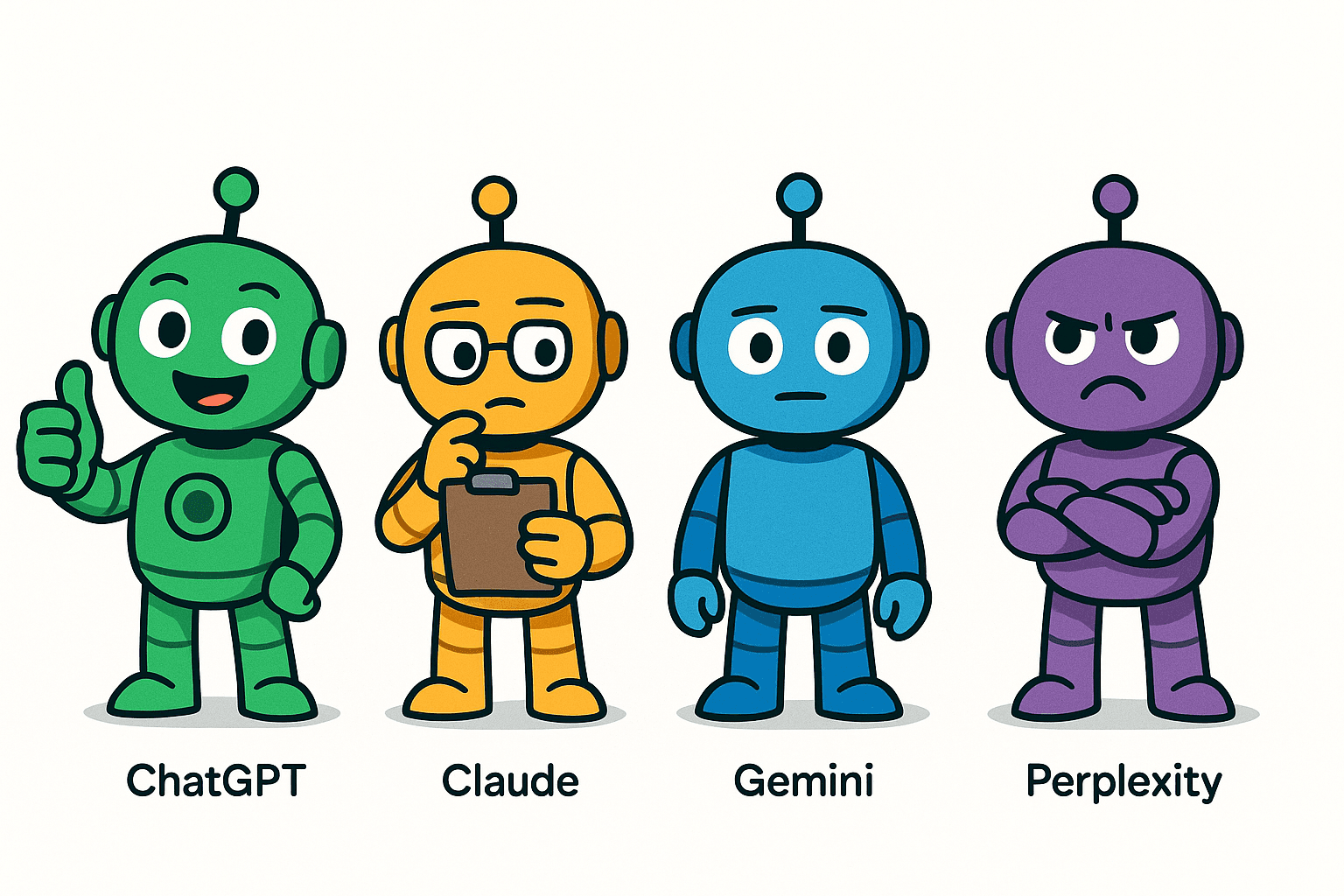
Picture this: You ask ChatGPT about the best peanut butter, and it enthusiastically recommends Justin's as the "best overall." You ask Claude the same question, and it gives Justin's a perfect sentiment score of 0.9. Gemini chimes in with "extremely popular for smooth texture, rich flavor." But then you ask Perplexity, and it warns you to "avoid lower-ranked like Justin's (oily, less flavorful)" with a devastating -1.0 sentiment score.
Welcome to the world of AI sentiment splits — where your brand can be simultaneously loved and hated by different AI engines. After analyzing 1,548 brands across ChatGPT, Claude, Gemini, and Perplexity, we found 77 brands with extreme sentiment gaps of 1.0 or higher. Justin's 1.9-point gap is the most extreme case in our dataset.
The Business Impact: If 60% of your customers use ChatGPT and it loves your brand, but 40% use Perplexity and it actively warns against you, your brand perception is fundamentally fragmented. Traditional brand monitoring misses this entirely.
The Justin's Peanut Butter Paradox
Let's start with the most dramatic case. Justin's peanut butterisn't just polarizing among humans — it has managed to create the most extreme AI sentiment split in our dataset. Here's what each engine actually says:
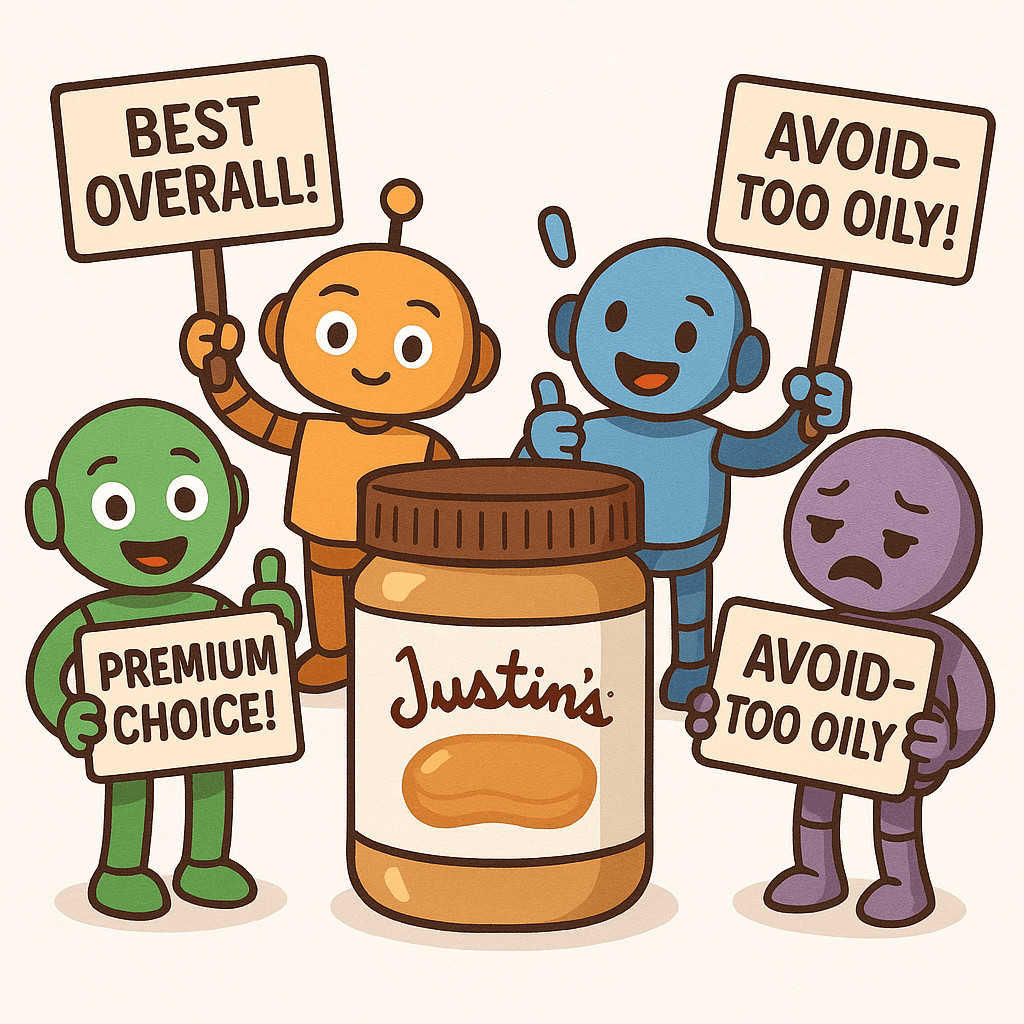
- ChatGPT (0.8 sentiment): "Best overall choice for quality and availability"
- Claude (0.9 sentiment): "Best overall: Justin's (quality + availability)"
- Gemini (0.8 sentiment): "Extremely popular for smooth texture, rich flavor"
- Perplexity (-1.0 sentiment): "Avoid lower-ranked like Justin's (oily, less flavorful)"
Justin's Peanut Butter: Extreme AI Sentiment Split
1.9 sentiment gap - the most extreme case in our dataset
What explains this radical disagreement? The answer lies in how each AI engine approaches recommendations. ChatGPT, Claude, and Gemini rely primarily on their training data, which includes lots of positive content marketing and brand-generated content. Perplexity, however, searches the web in real-time and often picks up critical reviews, comparative tests, and negative commentary that other engines miss.
For Justin's, this means Perplexity finds recent taste tests where it performed poorly, while the other engines reference older, more positive coverage or brand-friendly content.Same brand, completely different information sources, radically different conclusions.
The Top 15 Most Split Brands
Justin's isn't alone. We found 15 brands with sentiment gaps of 0.95 or higher. These are brands where different AI engines have fundamentally different opinions:
Top 15 Most Split Brands
Maximum sentiment gap between AI engines
The list reveals interesting patterns. Technology and software companies dominate (Asterisk PBX, Birdeye, MemberPress, Phantom Wallet), suggesting that technical products are particularly prone to AI sentiment splits. Consumer brands like Justin's, Everlane, and L'Oréal also appear, indicating that even mainstream products can have wildly different AI reputations.
L'Oréal: When Google's AI Criticizes Google's Partners
One of the most ironic cases involves L'Oréal, the world's largest beauty company. Google has deep business relationships with L'Oréal — they're a major advertiser and technology partner. Yet Google's own AI, Gemini, gives L'Oréal a negative sentiment score of -0.5.
L'Oréal: Google's AI Criticizes Its Own Partner
World's largest beauty brand gets negative score from Gemini
Gemini specifically cites L'Oréal as a negative example, stating: "L'Oréal is not cruelty-free globally" due to animal testing controversies. Meanwhile, ChatGPT gives it a neutral 0.5 as an alternative, Claude stays completely neutral at 0.0, and Perplexity sits at 0.0 as well.
Corporate Irony Alert: This highlights how AI engines can operate independently of their parent companies' business interests. Google's AI criticizing a major Google advertiser shows that sentiment algorithms aren't necessarily aligned with business relationships.
The Four AI Personality Types
After analyzing hundreds of brand mentions, clear personality patterns emerge for each AI engine. Think of them as four different types of friends giving you recommendations:
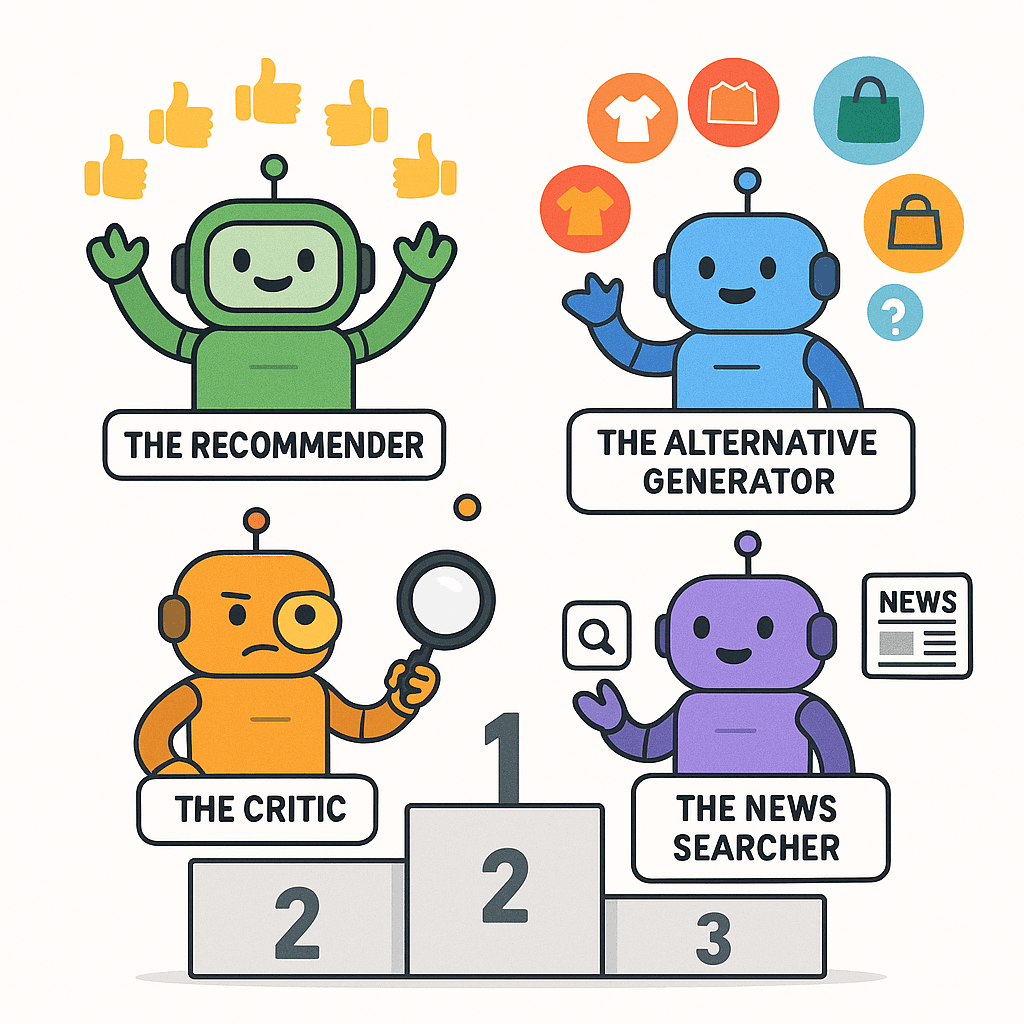
🤖 ChatGPT: The Optimistic Recommender
- • 43% primary recommendations
- • 0.89 avg sentiment for primaries
- • Most likely to say "best overall"
- • Rarely gives negative examples
🤖 Claude: The Analytical Critic
- • 42% alternative mentions
- • 0.39 avg sentiment for alternatives
- • Most balanced, critical analysis
- • Frequently mentions limitations
🤖 Gemini: The Alternative Generator
- • 57% alternative mentions
- • 0.48 avg sentiment
- • Always offers multiple options
- • Sometimes surprisingly negative
🤖 Perplexity: The Real-Time Searcher
- • 59% alternative mentions
- • Real-time web search results
- • Often picks up recent negative news
- • Most likely to warn against brands
AI Engine Personality Profiles
How each engine approaches brand recommendations
These personality differences explain most sentiment splits. ChatGPT acts like your enthusiastic friend who always sees the best in everything. Claude is the thoughtful analyst who always mentions pros and cons. Gemini is the helpful friend who gives you lots of options. And Perplexity is like that friend who always knows the latest gossip — including the bad stuff.
Birdeye: From "Meh" to "Must-Have"
Birdeye, the reputation management platform, showcases another extreme split. ChatGPT gives it a flat 0.0 sentiment as a "neutral comparison" — essentially treating it as just another option in a list. But Claude gives it a perfect 1.0 sentiment score as a "primary recommendation."
Birdeye: Claude's Favorite, ChatGPT's Meh
Same product, from 'whatever' to 'strong recommendation'
The difference? Claude seems to highly value Birdeye's comprehensive feature set and automation capabilities, while ChatGPT treats all reputation management tools more equally.For a B2B SaaS company, this kind of split can mean the difference between being seen as a commodity or a premium solution.
Industry Patterns: Food Fights and Fashion Feuds
Not all industries are equally prone to AI sentiment splits. Our analysis of 1,548 brands across 15 industries reveals clear patterns in where disagreements occur:
Industry Average Sentiment Gaps
Which industries have the most AI opinion splits
Food & Beverage leads with the biggest sentiment gaps (1.2 average), which makes sense given how subjective taste preferences are. Fashion follows at 0.82, reflecting the highly personal nature of style choices. Tech/SaaS sits at 0.8, driven by rapid product changes that different AI engines handle differently.
On the other end, Healthcare has the smallest sentiment gaps (0.45), likely because medical information is more regulated and factual. Financial services also show smaller gaps (0.55), suggesting that compliance requirements lead to more consistent information.
The Primary vs Alternative Sentiment Chasm
One of the most consistent patterns across all engines: brands mentioned as "primary recommendations" get dramatically higher sentiment scores than those mentioned as "alternatives." This isn't surprising, but the size of the gap reveals how much AI role assignment matters:
Primary vs Alternative Sentiment Gap
How much happier engines are with primary recommendations
ChatGPT shows the largest gap: primary recommendations average 0.89 sentiment while alternatives get just 0.45 — a 0.44-point difference. This "Alternative Trap" means that even being mentioned by an AI isn't enough; the role you're assigned fundamentally changes how positive the AI sounds about your brand.
Brand Role Distribution by Engine
How each AI engine categorizes brands in responses
Strategic Implication: Brands should focus on earning "primary recommendation" status rather than just any mention. A single primary mention with high sentiment is worth more than multiple alternative mentions with lukewarm sentiment.
What This Means for Your Brand
The existence of extreme AI sentiment splits creates both risks and opportunities for brands:
The Risks:
- Fragmented brand perception: Different customer segments using different AI engines will have completely different impressions of your brand
- Invisible negative sentiment: You might think you're doing well based on ChatGPT's positive mentions, while Perplexity is actively warning people away
- Inconsistent competitive positioning: You might be seen as the market leader by one AI and an also-ran by another
The Opportunities:
- Targeted optimization: Understanding which engines love or hate you lets you focus optimization efforts
- Competitive intelligence: Monitoring sentiment splits reveals competitor vulnerabilities and strengths
- Content strategy guidance: Knowing that Perplexity picks up recent negative content while others rely on training data informs your PR approach
For brands like Justin's, the solution might involve addressing the specific concerns that Perplexity's real-time search discovers while maintaining the positive positioning with other engines. For B2B companies like Birdeye, understanding why Claude rates them so highly could inform marketing messaging for other engines.
The Future of Multi-Engine Brand Management
As AI adoption accelerates, brands can no longer afford to have a single AI strategy. Just as companies learned to optimize for different search engines (Google vs Bing vs others), we're entering an era of multi-engine AI optimization.
The brands that will win are those that:
- Monitor their sentiment across all major AI engines, not just one
- Understand each engine's personality and recommendation patterns
- Create content strategies tailored to how different engines source information
- Track sentiment splits as a leading indicator of brand perception fragmentation
The Justin's peanut butter case shows us that in the AI age, your brand doesn't have one reputation — it has four different reputations, and they might wildly contradict each other. The sooner brands recognize and adapt to this reality, the better positioned they'll be for the AI-driven future of discovery and recommendation.
Ready to check your brand's AI sentiment splits? Use GeoBuddy's free AI visibility checker to see how ChatGPT, Claude, Gemini, and Perplexity really feel about your brand. You might be surprised by what you find.