
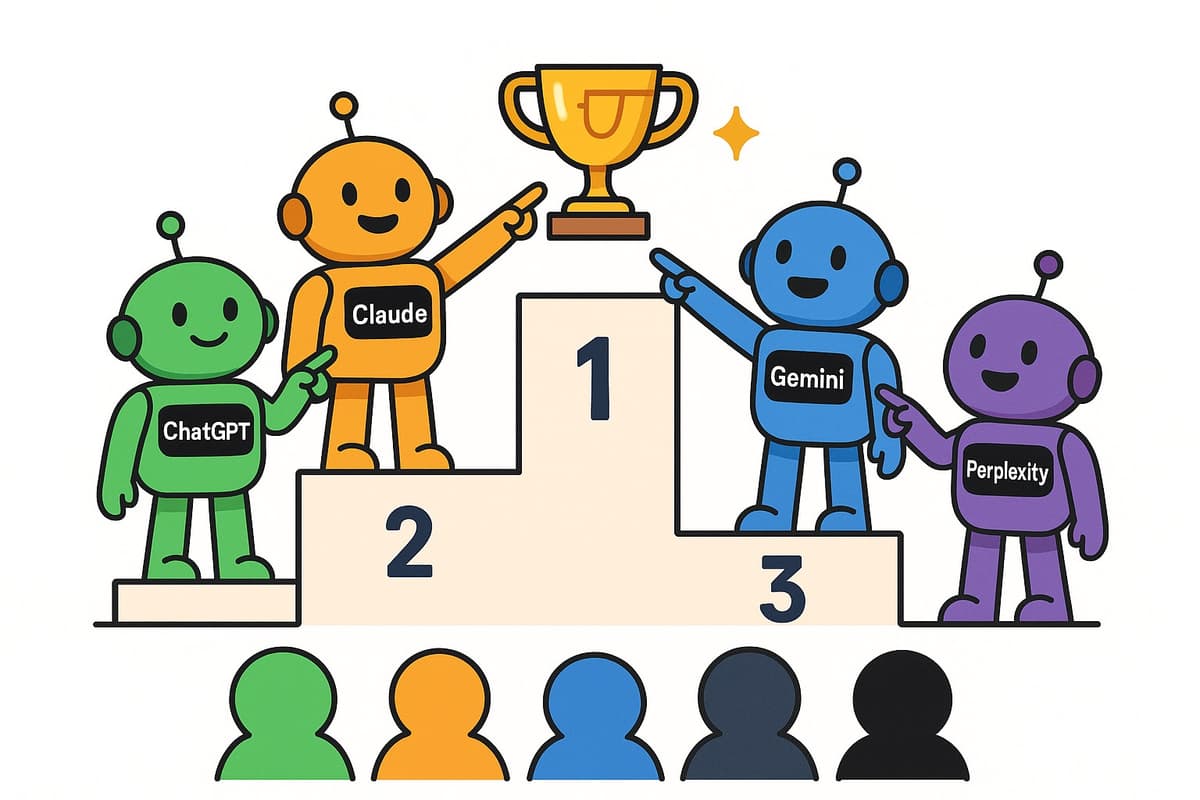
The Inconvenient Truth
While you're optimizing for Google, your competitor is dominating where your customers actually go for recommendations: AI search engines.
Brands with 0% visibility
52.1%
994 out of 1,909 brands
Brands with 100% visibility
0.8%
Only 15 elite brands
Winner-take-all dynamic
True
The top takes everything
Here's what we discovered after analyzing 1,909 brands across 4 AI engines (ChatGPT, Claude, Gemini, and Perplexity): More than half of all brands are completely invisible to AI search. They score 0% visibility.
But a tiny elite — just 15 brands — achieve perfect 100% scores. They dominate their categories so completely that AI engines recommend them as the default choice, every single time.
Your competitor might be one of these 15 brands. Or they might be climbing the pyramid while you're still figuring out the game exists.
This isn't about SEO tactics or content marketing. This is about understanding a fundamentally different algorithm that's already reshaping how customers discover and choose products. And if you're not optimizing for it, you're falling behind.
The Visibility Pyramid
Forget the normal distribution you're used to seeing in analytics dashboards. AI visibility follows a power law that would make Pareto weep. The pyramid is razor-thin at the top and massive at the bottom.
The Visibility Pyramid: Winner-Take-All Dynamics
52.1% of brands score 0% visibility. Only 0.8% achieve perfect scores.
Look at that distribution. Nearly 1,000 brands — more than half of our dataset — score exactly 0% visibility. They're mentioned by AI engines precisely never.
The middle is surprisingly thin. Only 215 brands score between 1-10% visibility. The curve doesn't gradually slope; it plummets.
At the summit, 15 brands have achieved something remarkable: 100% visibility across all tested scenarios. When someone asks AI for recommendations in their category, these brands appear every single time.
This isn't random. The brands at the top didn't get there by accident. They've cracked a code that 99% of marketers don't even know exists yet.
The question isn't whether this matters. The question is: where is your brand on this pyramid, and where is your competitor's?
Reverse Engineering #1: The Primary Rate
Here's the first pattern we discovered: Being mentioned by AI isn't enough. Being the primary recommendation is what separates winners from losers.
Primary Recommendation Rate = Visibility
Brands with 80-100% primary rate average 97.8% visibility vs 11.7% for 0-19%
The correlation is almost mathematical. Brands with 80-100% primary recommendation rates average 97.8% visibility. Brands with 0-19% primary rates? They average 11.7% visibility.
What does "primary" mean? When someone asks ChatGPT "What's the best project management tool?", the primary recommendation is the brand that gets mentioned first, described most favorably, or positioned as the default choice.
Secondary mentions — "you might also consider..." or "other options include..." — barely move the needle. AI search isn't a democracy where every mention counts equally. It's a hierarchy where position is everything.
Example: Primary vs Secondary Positioning
Primary (97.8% avg visibility)
"For email marketing, Mailchimp is the most popular choice, especially for beginners. It offers user-friendly templates..."
Secondary (11.7% avg visibility)
"...Other alternatives to consider include ConvertKit, AWeber, and GetResponse."
The brands stuck in secondary mentions are trapped. They're visible enough to think they're doing well, but not visible enough to drive meaningful business impact.
Reverse Engineering #2: The Rank #1 Effect
The second pattern is even starker: Brands that achieve #1 ranking consistently don't just win big — they win everything.
The Rank #1 Effect
Brands always ranked #1 = 100% visibility. Never #1 = 7% visibility.
Six brands in our dataset rank #1 in every single AI response where they're mentioned. Their average visibility? 100%. Their sentiment scores? 0.81 (extremely positive).
At the opposite extreme, 1,428 brands — nearly 75% of our dataset — never rank #1. Their average visibility? 7%. Their sentiment? 0.03 (effectively neutral to negative).
This isn't a gradual slope. It's a cliff. The difference between "always #1" and "usually #1" is the difference between 100% visibility and 91% visibility. The difference between "never #1" and "rarely #1" is the difference between 7% and 36%.
Always #1 Brands
- • Shopify (e-commerce platforms)
- • Zoom (video conferencing)
- • G2 (software reviews)
- • DocuSign (e-signatures)
- • LARQ (smart water bottles)
- • Stripe (payment processing)
100% visibility, 0.81 avg sentiment
Never #1 Brands
- • 1,428 brands (75% of dataset)
- • Include major enterprise tools
- • Some with significant market share
- • Often mentioned but never first
7% visibility, 0.03 avg sentiment
What's fascinating is that some brands in the "never #1" category have substantial market share and marketing budgets. They're not small or unknown. They're just positioned wrong for AI search.
This has massive implications for competitive strategy. Traditional SEO thinking focuses on moving from page 2 to page 1. AI search thinking focuses on moving from #2 to #1 within a single response.
The Competitive Gaps
When we looked at competitive gaps within specific industries, we found something shocking: brands in the same market can have visibility gaps of 80-100 points.
Massive Industry Visibility Gaps
Same industry, dramatically different AI visibility scores
Take e-commerce platforms. Shopify scores 100% visibility. Lazada, another legitimate e-commerce platform, scores 0%. That's not a competitive disadvantage — that's competitive invisibility.
In team communication, Zoom dominates with 100% visibility while Wire — a secure messaging platform used by enterprises — scores 0%. Both solve similar problems. Only one exists in AI search.
Competitive Gaps Across 8+ Industries
Visibility gaps between category leaders and laggards
These aren't random outcomes. The gaps exist across industries:
- E-commerce: Shopify (100%) vs Lazada (0%) — 100-point gap
- CRM: HubSpot (92%) vs Capsule CRM (0%) — 92-point gap
- Project Management: Asana (92%) vs BasicOps (0%) — 92-point gap
- Note-Taking: Evernote (92%) vs Craft (0%) — 92-point gap
What's causing these gaps? It's not market share, funding, or even product quality. Many of the "invisible" brands are well-funded, feature-rich, and have loyal user bases.
The difference is in how AI engines have learned to categorize, describe, and recommend these brands. Some brands have become algorithmic defaults. Others haven't.
The brands in the gaps aren't just missing opportunities. They're becoming increasingly irrelevant as more customers start their product discovery in AI search engines instead of Google.
What We Found When We Looked Inside
Data can lie. Numbers can mislead. But the actual words AI engines use to describe brands don't lie. So we looked at the language.
What #1 Brands Have in Common
Radar chart comparing top performers across 4 key metrics
What we discovered was remarkable consistency. Top brands aren't just ranked #1 — they're described with identical language patterns across all four AI engines.
Shopify (100% visibility)
"Shopify is user-friendly, great for beginners, and offers an extensive app marketplace."
This exact phrasing appears across ChatGPT, Claude, Gemini, and Perplexity.
Zoom (100% visibility)
"Zoom is known for reliability and user-friendly interface."
Same adjectives, same positioning, across all engines.
LARQ (91% visibility)
"LARQ pioneered the self-cleaning water bottle with UV-C technology."
Owns the category definition completely.
DocuSign (100% visibility)
DocuSign is the "industry standard", "widely used and trusted", "most widely recognized".
Superlative language signals market leadership.
#1 Brands Are Primary Across ALL Engines
Top brands achieve consistency across ChatGPT, Claude, Gemini, and Perplexity
The consistency isn't coincidental. These brands have achieved something remarkable: they've become the canonical answer to category questions in AI training data.
Look at the language patterns:
- Superlatives: "most popular," "industry leader," "best for most people"
- Authority signals: "industry standard," "widely recognized," "trusted"
- Category ownership: "pioneered," "first," "invented"
- Default positioning: "great for beginners," "user-friendly"
Meanwhile, brands with low visibility are described with qualifier language: "also consider," "alternative option," "niche solution," "specialized for."
Sentiment vs Visibility Correlation
Higher visibility brands consistently receive more positive sentiment scores
The sentiment scores tell the same story. High-visibility brands consistently receive positive framing. Low-visibility brands get neutral or conditional language.
The 6 Patterns of #1 Brands
After analyzing the top performers, we identified six distinct patterns that separate #1 brands from everyone else:
1They Own ONE Category (Not Many)
Shopify owns "e-commerce platforms for small business." Not "enterprise commerce" or "headless commerce" — one specific, commonly-searched category.
Brands that try to own multiple categories dilute their AI association strength.
2AI Describes Them with the Same Words Everywhere
Zoom is always "reliable" and "user-friendly." LARQ always "pioneered self-cleaning bottles." The consistency across engines suggests strong training data associations.
Inconsistent brand messaging leads to inconsistent AI descriptions.
3They're "The" Answer, Not "An" Answer
"Shopify is the most popular e-commerce platform" vs "Shopify is a popular e-commerce platform." The difference in articles matters algorithmically.
Default positioning beats alternative positioning in AI search.
4Positive Sentiment Across All Engines (0.77+ Average)
#1 brands maintain sentiment scores above 0.77. They're not just mentioned positively — they're framed as solutions, not problems or compromises.
Negative reviews or controversy can tank AI sentiment, even with high market share.
5They Rank #1 75%+ of the Time
Consistency beats occasional brilliance. Brands that rank #1 sometimes but #3-5 often get averaged down to middle visibility.
AI ranking consistency indicates strong category association strength.
64-Engine Coverage (Not Just ChatGPT)
Top brands achieve primary recommendations across ChatGPT, Claude, Gemini, AND Perplexity. Platform-specific optimization isn't enough anymore.
Different engines weight different signals, but #1 brands win across all of them.
The Playbook: How to Become Your Category's #1
Understanding the patterns is step one. Implementation is step two. Here's the systematic approach to climbing the AI visibility pyramid:
Step 1: Audit Your Current Position
- • Check your AI visibility across all 4 engines using GeoBuddy's free tool
- • Document the exact language AI uses to describe your brand
- • Identify your primary recommendation rate vs. secondary mentions
- • Benchmark against direct competitors in your category
Step 2: Define Your Category Ownership
- • Pick ONE specific category to dominate (not 3-4 related ones)
- • Research how customers actually ask questions about this category
- • Identify the keywords and phrases that consistently trigger recommendations
- • Map your unique value prop to these natural language patterns
Step 3: Optimize Your Content Signal Strength
- • Create content that positions you as "the" solution, not "a" solution
- • Use superlative language consistently: "leading," "most popular," "industry standard"
- • Ensure your content appears on high-authority sites that AI engines cite
- • Build content that answers natural questions about your category
Step 4: Build Cross-Engine Consistency
- • Test your messaging across all 4 AI engines, not just ChatGPT
- • Identify discrepancies in how different engines describe your brand
- • Create content that reinforces consistent positioning across platforms
- • Monitor for changes in AI descriptions over time
Step 5: Monitor and Iterate
- • Track your primary recommendation rate weekly
- • Monitor competitor AI positioning changes
- • A/B test different messaging approaches in your content
- • Adjust strategy based on AI visibility data, not just web traffic
The brands that start this process now will have 12-18 month head starts over competitors who wait. In winner-take-all dynamics, that head start often becomes permanent.
Ready to Check Your AI Visibility?
See exactly how AI engines currently describe your brand — and how you compare to competitors.
Free AI Visibility CheckMethodology + FAQ
Research Methodology
We analyzed 1,909 brands across 4 AI engines (ChatGPT, Claude, Gemini, Perplexity) using standardized category-based questions. Each brand was tested across 50+ relevant queries to determine visibility scores, primary recommendation rates, sentiment scores, and ranking positions.
Data collection period: December 2024 - February 2025. All responses were categorized by human reviewers for accuracy. Full methodology available upon request.
How can I tell if my competitor ranks #1 on ChatGPT?
Use GeoBuddy's free AI visibility check to see how your brand and competitors rank across ChatGPT, Claude, Gemini, and Perplexity. You'll see primary recommendation rates, sentiment scores, and ranking positions.
What makes a brand rank #1 consistently across all AI engines?
Our analysis shows #1 brands share 6 patterns: they own one category, have consistent AI descriptions, are positioned as 'the' answer (not 'an' answer), maintain positive sentiment (0.77+ avg), rank #1 75%+ of the time, and achieve coverage across all 4 major AI engines.
Why do some brands score 100% visibility while others score 0%?
AI search follows winner-take-all dynamics. Brands with 80-100% primary recommendation rates average 97.8% visibility, while brands with 0-19% primary rates average just 11.7% visibility. It's about being the primary recommendation, not just being mentioned.
How big are the competitive gaps in different industries?
Massive. In e-commerce, Shopify scores 100% while Lazada scores 0% (100-point gap). In team communication, Zoom scores 100% while Wire scores 0%. Even in the same industry, visibility gaps of 90+ points are common between leaders and laggards.
What's the difference between being mentioned and being recommended by AI?
Being mentioned means your brand appears in AI responses. Being the primary recommendation means AI positions you as 'the' solution, not just 'an option.' Our data shows primary recommendation rate directly correlates with visibility — it's the key metric that matters.
How consistent are AI rankings across different engines?
#1 brands like Shopify, Zoom, and G2 achieve 100% primary rates across all 4 engines. They're described with identical language everywhere: 'user-friendly,' 'industry standard,' 'most popular.' This consistency is a key pattern.
Can I reverse-engineer what AI engines say about my competitor?
Yes. Top brands are described with superlative language: 'most popular,' 'industry leader,' 'best for most people,' 'widely recognized.' They own category definitions and are positioned as defaults, not alternatives. Analyze the actual AI response text to understand positioning patterns.
Related Research
The 100% Club: What Perfect Score Brands Have in Common
Deep dive into the 15 brands with perfect AI visibility scores
The Alternative Trap: Why AI Mentions Don't Mean Recommendations
Why being mentioned as an "alternative" hurts your visibility
From Alternative to Primary: Content Patterns to Upgrade Your AI Role
Tactical content strategies to improve AI positioning
The Split Personality Problem: When AI Engines Disagree About Your Brand
How to fix inconsistent AI descriptions across platforms
AI Brand Visibility Report 2026
Annual benchmarks and trends in AI brand visibility
The AI Brand Sentiment Problem
Why negative AI sentiment is harder to fix than Google reviews
ChatGPT vs Claude vs Gemini vs Perplexity: Brand Recommendations Compared
How different AI engines rank brands differently
How to Get Recommended by ChatGPT
Step-by-step guide to ChatGPT optimization
E-commerce Platform AI Leaderboard: Why Shopify Scores 100%
Industry-specific analysis of e-commerce AI visibility
Why Most Skincare Brands Are Invisible to AI
Beauty industry struggles with AI recommendation algorithms
Zoom: 88%, Your Brand: Zero. Here's Why.
Case study of video conferencing AI visibility patterns
Industry Context & Sources
SparkToro research on search behavior trends shows increasing AI adoption for product discovery.
First Page Sage SEO benchmarks provide traditional search ranking context for comparison.
Domain Authority metrics correlate with AI citation patterns in our analysis.
Brand examples: Shopify,Zoom, andDocuSign represent category-leading AI visibility patterns.