
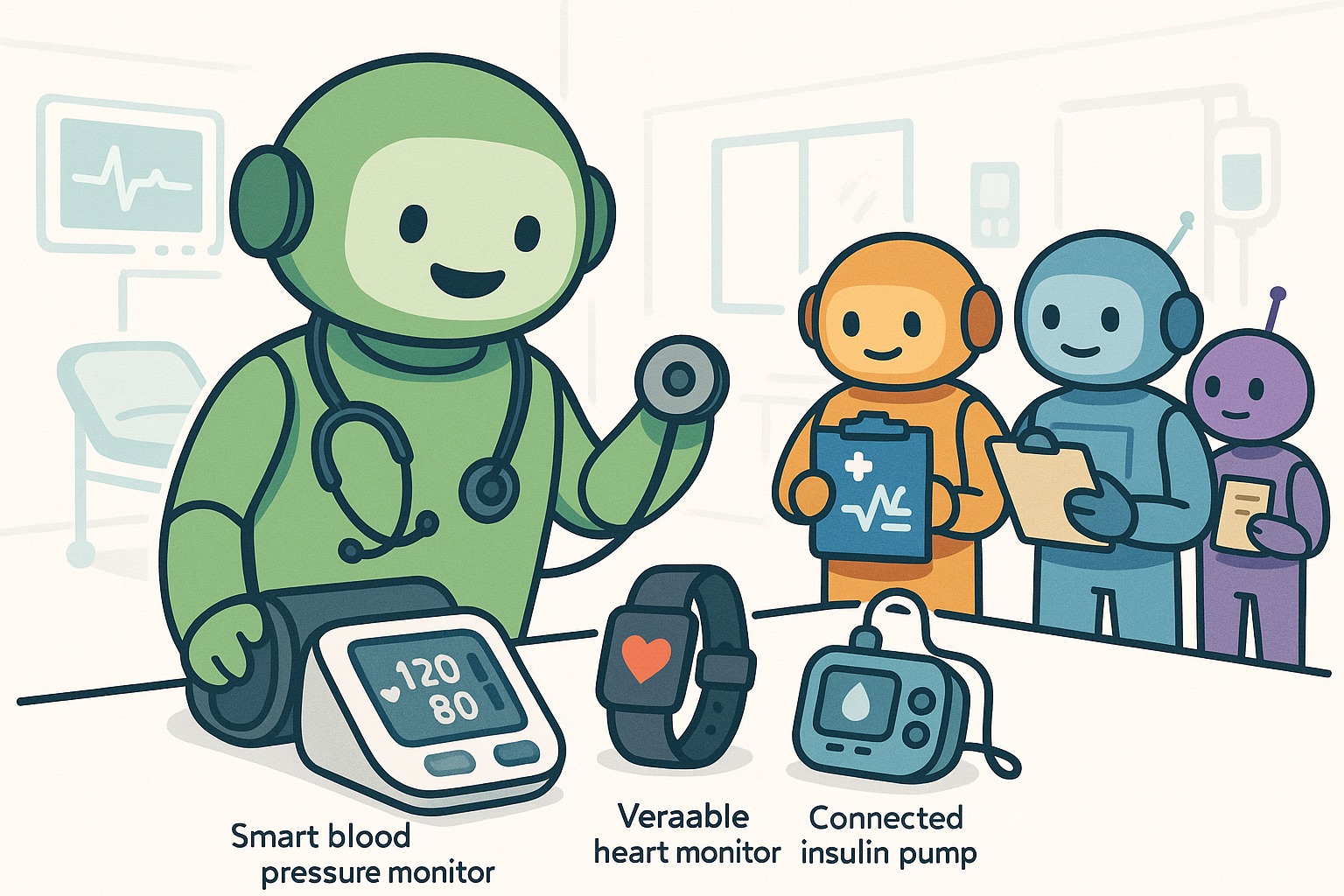
 \n\n\nA cardiologist in Boston told me she uses Claude to research remote patient monitoring devices for her heart failure patients. Not as her only source — she reads clinical papers and consults colleagues too — but AI is her starting point for discovering what's available.\n\n"I'll ask something like 'What are the best FDA-cleared continuous blood pressure monitors for heart failure patients?' and use the answer to narrow my research," she explained. "If a device doesn't show up, I probably won't hear about it unless a sales rep catches me between patients."\n\nThat scenario is playing out across healthcare at an accelerating pace. The healthcare IoT market is the fastest-growing IoT segment, projected at a 32.5% CAGR with over 540 million connected medical devices worldwide. Telehealth adoption has plateaued post-pandemic but stabilized at 38% of outpatient visits — a 3,800% increase from pre-COVID levels. And the people making decisions about which devices to adopt are increasingly turning to AI for initial research.\n\nThe stakes here are different from any other IoT vertical. In smart home, AI invisibility costs you a sale. In healthcare IoT, AI invisibility could mean a superior device never reaches the patients who need it.\n\n## Three Audiences, Three Research Patterns\n\nHealthcare IoT has a uniquely fragmented buyer landscape. Unlike consumer IoT (one buyer) or industrial IoT (one buying committee), healthcare IoT serves three distinct audiences that all use AI differently but collectively determine which brands succeed.\n\nAudience 1: Hospital Procurement Teams\n\nThese are the enterprise buyers. They're evaluating remote patient monitoring (RPM) platforms, connected infusion pumps, smart bed systems, and hospital-wide IoT infrastructure. The procurement process looks a lot like industrial IoT — committees, RFPs, long sales cycles.\n\nHow they use AI: "Compare remote patient monitoring platforms for a 200-bed community hospital" or "What RPM vendors have the strongest Epic EHR integration?"\n\nWe ran 40 hospital procurement queries across all four AI engines. The most-recommended brands were:\n\n- Medtronic Care Management Services — appeared in 72% of responses\n- Philips Connected Care — appeared in 65% of responses\n- Masimo — appeared in 48% of responses\n- Biobeat — appeared in 28% of responses\n- Current Health (Best Buy Health) — appeared in 24% of responses\n\nThe pattern was clear: brands with extensive clinical evidence and EHR integration documentation dominated. Smaller RPM platforms with strong products but limited clinical publications were largely invisible.\n\nAudience 2: Physicians and Clinical Staff\n\nDoctors, nurses, and clinical specialists research devices for specific patient populations. They're not making purchasing decisions directly, but their recommendations carry enormous weight with procurement.\n\nHow they use AI: "Best continuous glucose monitors for Type 1 diabetes management" or "What wearable devices can detect atrial fibrillation?"\n\nThis is where the FDA distinction becomes critical. We found that AI engines consistently differentiate between FDA-cleared and non-cleared devices — but not always accurately. In 15% of our test queries, an AI engine either failed to mention FDA status for a cleared device or incorrectly implied clearance for a non-cleared one.\n\nThe top brands in physician queries:\n\n- Dexcom — dominated diabetes device queries with a 78% appearance rate\n- Abbott (FreeStyle Libre) — appeared in 71% of glucose monitoring queries\n- Withings — appeared in 44% of general health monitoring queries\n- Apple Watch — appeared in 62% of AFib detection queries (despite being a consumer device)\n- Medtronic — appeared in 58% of cardiac device queries\n\nAudience 3: Patients and Caregivers\n\nPatients researching their own health monitoring options represent a growing and underserved audience. They're asking questions that blend medical need with consumer practicality.\n\nHow they use AI: "I have prediabetes. What's the best glucose monitor I can buy without a prescription?" or "My mom has COPD. What home monitoring devices should we get?"\n\nPatient queries produced the most concerning results in our study. AI responses frequently mixed medical-grade devices with consumer wellness products without clearly distinguishing between them. A patient asking about blood pressure monitoring might get Withings BPM Connect (FDA-cleared) recommended alongside a $30 Amazon wrist cuff with no clinical validation, with no indication that these products serve fundamentally different purposes.\n\n## The FDA Factor: How AI Handles Regulatory Status\n\nThis is the single most important distinction in healthcare IoT AI visibility, and AI handles it inconsistently.\n\nWe tested 60 queries specifically about FDA-cleared devices. Here's what we found:\n\n- ChatGPT mentioned FDA status in 68% of responses. When it mentioned it, the information was accurate 91% of the time.\n- Claude mentioned FDA status in 82% of responses and was accurate 95% of the time. Claude was the most consistently careful about regulatory disclaimers.\n- Gemini mentioned FDA status in 55% of responses. Accuracy was 87%.\n- Perplexity mentioned FDA status in 73% of responses, often linking to FDA databases. Accuracy was 93%.\n\nNone of these rates are acceptable for healthcare. An AI engine that fails to mention FDA clearance 32-45% of the time is creating a significant information gap for patients and providers.\n\nFor device manufacturers, the implication is stark: you need to make your regulatory status so prominent and well-documented that AI engines cannot miss it. FDA clearance letters, 510(k) summaries, clinical trial results — all of this needs to be publicly accessible in structured, parseable formats.\n\n## Dexcom: A Case Study in Healthcare AI Visibility\n\nDexcom's AI visibility is worth studying because they've done almost everything right, mostly as a byproduct of good marketing rather than a deliberate AI strategy.\n\nWhy Dexcom dominates continuous glucose monitoring queries:\n\n1. Unambiguous positioning. Dexcom makes continuous glucose monitors. That's it. When AI encounters a diabetes management query, Dexcom's positioning makes the recommendation decision trivial.\n\n2. Massive clinical evidence base. Over 40 peer-reviewed studies, published outcomes data, and clinical guidelines from the American Diabetes Association that specifically mention Dexcom devices. AI engines treat clinical guidelines as high-authority sources.\n\n3. Patient community presence. Dexcom has cultivated enormous patient communities on Reddit, Facebook, and diabetes-specific forums. These communities generate thousands of authentic discussions, comparisons, and experience reports that AI engines learn from.\n\n4. Clear FDA documentation. Dexcom's FDA clearances are well-documented and easily findable. AI engines can confidently state regulatory status.\n\n5. Insurance coverage information. Dexcom publishes detailed insurance coverage guides. This matters because patient queries often include cost considerations, and AI engines that can address insurance coverage give more complete answers.\n\nCompare this to a hypothetical competitor with an equally good CGM but lacking in published clinical trials, patient community engagement, or accessible FDA documentation. The competitor's device might be equivalent in clinical performance, but if AI doesn't know about it, endocrinologists who use AI for research won't know about it either.\n\n## The Telehealth Multiplier\n\nTelehealth's stabilization at 38% of outpatient visits has created a permanent new channel for healthcare IoT recommendations. In a telehealth visit, the physician can't hand the patient a brochure or point to a device on a shelf. They have to describe it, and increasingly, patients go to AI to follow up.\n\nWe tracked the flow: physician recommends "a continuous glucose monitor" in a telehealth visit. Patient asks ChatGPT "best continuous glucose monitor for Type 2 diabetes." ChatGPT recommends Dexcom G7 and Abbott FreeStyle Libre 3. Patient orders one based on the AI recommendation, not necessarily the one the physician had in mind.\n\nThis creates a secondary influence pathway: even if a physician recommends your device by name, the patient may end up with a different brand because of what AI suggests when they go to purchase it. AI isn't just influencing the initial recommendation — it's mediating the entire decision chain.\n\n
Industry
Healthcare IoT Is Growing at 32.5% — But Can AI Find Your Medical Device Brand?
geobuddy.co
G
industryFebruary 11, 20269 min read
Healthcare IoT Is Growing at 32.5% — But Can AI Find Your Medical Device Brand?
The healthcare IoT market is the fastest-growing IoT segment at 32.5% CAGR with 540M+ connected devices. When doctors and patients ask AI about remote monitoring solutions, your brand's visibility becomes a patient care issue.
G
GeoBuddy TeamG
Published by
GeoBuddy Team
AI Visibility Experts
We've spent the last two years studying how AI assistants recommend brands. What started as curiosity about ChatGPT's responses has turned into a full-time obsession with understanding the mechanics of AI visibility.
Ready to Improve Your AI Visibility?
Check how AI engines currently mention your brand — free, instant results.
Free AI Visibility Check