
Ask ChatGPT for a video conferencing tool. Zoom appears 88% of the time — as the primary recommendation, not an afterthought. Ask about e-commerce platforms and Shopify is there 100% of the time. Ask about your brand? Probably silence.
We analyzed 1,548 brands across ChatGPT, Claude, Gemini, and Perplexity to answer a simple question: why do some brands become AI's default answer while most brands never appear at all?
The answer isn't what most marketers expect. It's not about technical SEO tricks. It's not about having the biggest budget. And it's definitely not about llms.txt files. It's about something more fundamental — and more actionable.
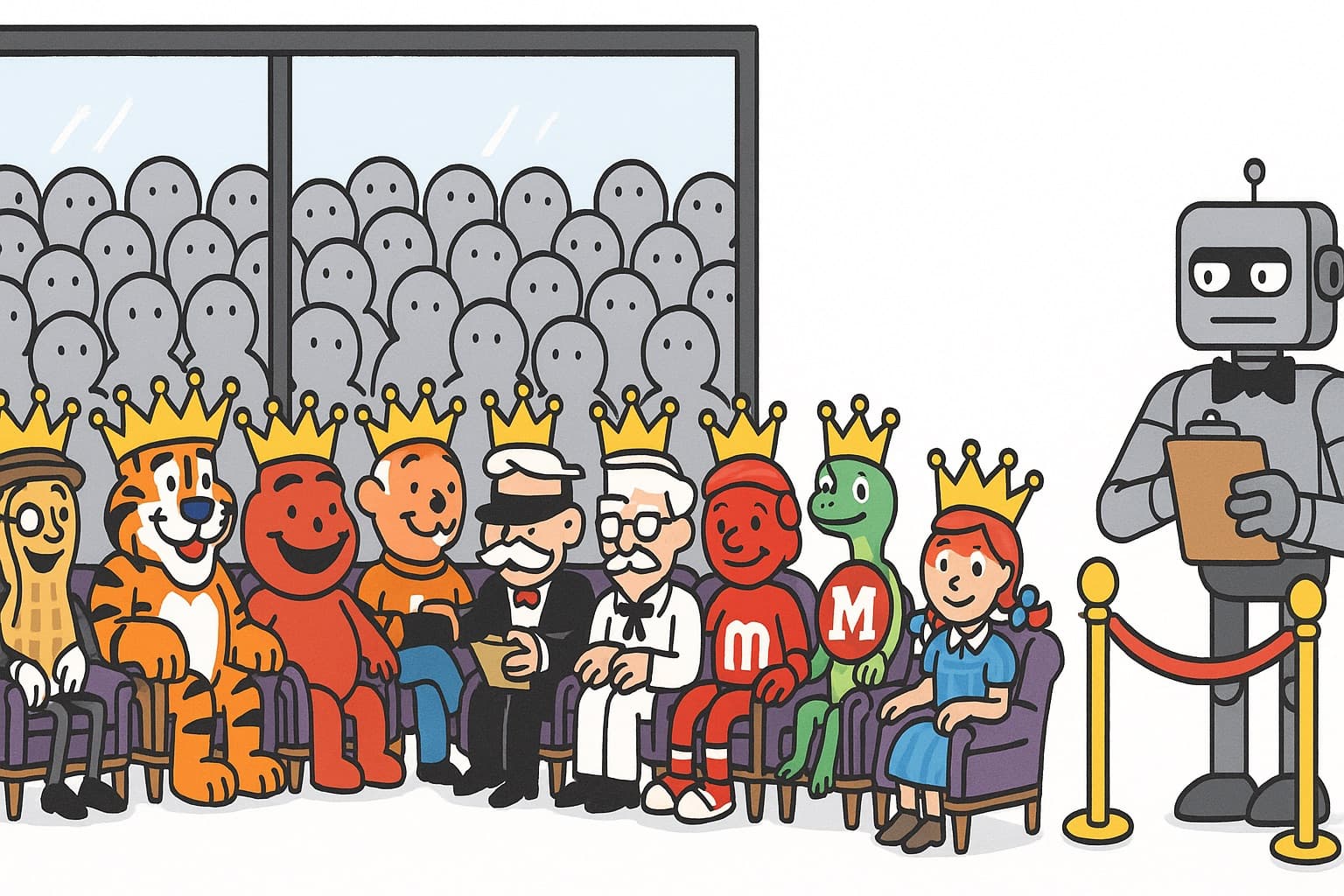
The Default Brands: Who Gets 80%+ Primary Rate
"Primary recommendation" means something specific: AI doesn't just mention your brand — it recommends you first. Before alternatives. Before caveats. You're the answer, not an option.
Out of 1,548 brands, only 18 achieve a primary rate above 75%. Five hit a perfect 100% — every single AI response positions them as the top pick. Here's the full leaderboard.
Primary Recommendation Rate: Top 18 Brands
Percentage of AI responses where the brand is the #1 recommendation — not just mentioned
The 100% Club is tiny. G2, Shopify, Zendesk, Unbounce, and Signal — five brands that are always the primary recommendation. None are the biggest company in tech. They're just undeniably the best answer in their specific niche. Signal isn't the most popular messaging app — but it's the only answer for "private messaging."
Now look at the other side. Here's where most brands land:
Primary Rate Distribution Across 1,548 Brands
50% of brands are NEVER the primary recommendation. Only 5 achieve 100%.
780 brands — over half — have a 0% primary rate. They may occasionally get mentioned as alternatives, but they are never AI's first choice. When a potential customer asks "what's the best tool for X?" — they're invisible.
The Pattern: 5 Traits Default Brands Share
We reverse-engineered what makes the top 18 brands different. Five traits emerged — and one conspicuous absence that challenges everything GEO consultants are selling.
The 5 Traits of Default AI Brands
100% primary brands have ALL 4 organic traits — but llms.txt is rare even among top performers
1. Category Authority (100%)
Every high-primary brand is the undisputed leader in its niche. Not top 5. Not "well-known." The definitive answer. Zoom doesn't compete for video calls — it is video calls in AI's model. Shopify is e-commerce. G2 is software reviews. When AI can confidently say "the best X is Y," Y gets the primary slot.
2. Review Site Presence (100%)
G2, Capterra, Trustpilot — every 100% primary brand has deep review profiles. AI engines use structured third-party validation as a confidence signal. Reviews don't just help your Google ranking. They train AI to trust your brand enough to recommend it first.
3. Regular Content Publishing (100%)
All top brands publish ongoing, category-defining content. Not SEO spam — genuine expertise that shapes how people think about the category. Shopify's guides literally teach AI how e-commerce works. Your content doesn't just rank — it trains.
4. Wikipedia Article (100%)
Wikipedia is one of the most heavily weighted sources in AI training data. Every brand at 100% primary rate has a detailed Wikipedia presence. It's not something you can fake — you need genuine notability — but it's one of the highest-ROI investments for AI visibility.
5. llms.txt or Structured Data? Only 18%
Here's the kicker: only 18% of top-performing brands use llms.txt or advanced structured data for AI. The vast majority achieved their dominant position without any technical GEO optimization. This doesn't mean technical work is useless — but it proves that brand fundamentals beat technical tricks.
What 100% Primary Brands Have in Common
Comparing brands with 100% primary rate vs 80%+ vs average across key traits
The uncomfortable truth: If you're spending money on llms.txt files and AI-specific technical SEO before you've built genuine category authority, you're optimizing the wrong thing. The data is clear: no amount of structured data can substitute for being the real answer.
Industry Matters More Than Size
One of the biggest surprises: your industry's baseline matters more than your company's size. Some industries naturally produce dominant brands that AI recommends confidently. Others are so fragmented that even market leaders get recommended inconsistently.
Primary Recommendation Rate by Industry
Some industries naturally produce 'default' brands. Others are a free-for-all.
Team Communication averages ~65% primary rate. When someone asks for a team messaging tool, AI almost always has a clear #1 answer (Slack, Teams). But Coffee Chains average just 12%. Ask "what's the best coffee chain" and AI hedges — it lists Starbucks, Blue Bottle, Peet's, and local shops as equal options. The category is too fragmented for a "default."
This matters because it sets your achievable ceiling. In a category like CRM (33% avg), even a dominant brand like Salesforce only gets recommended as primary ~45% of the time — AI always mentions HubSpot, Pipedrive, and others. In team communication, Slack can hit 65%+ because the alternatives are fewer and weaker.
The Niche Strategy: Small Brands Beating Giants
The most actionable finding in this research: you don't need to be big. You need to be specific.
Look at the leaderboard again. LARQ — a self-cleaning water bottle startup — achieves 83% primary rate. That's almost as high as Zoom. Why? Because when someone asks "what's the best self-cleaning water bottle?" there's only one answer. LARQ owns a tiny category completely.
Signal hits 100% primary. It's not the most-used messaging app — WhatsApp and Telegram dwarf it in users. But for "private messaging" or "encrypted messaging," Signal is the undisputed answer. No AI engine hedges.
Unbounce gets 100% for landing pages. Not website builders — just landing pages. That specificity is everything.
Visibility vs Primary Rate: The Four Quadrants
High visibility doesn't guarantee being the #1 pick. Niche brands can dominate their category.
⭐ Stars — High Vis, High Primary
Shopify, Zoom, G2, Signal — the AI defaults
🏢 Commodity — High Vis, Low Primary
Known, but always "one of many" options
🎯 Niche Dominators — Low Vis, High Primary
Small but undeniably #1 when mentioned
👻 Invisible — Low Vis, Low Primary
Where most brands sit — rarely mentioned, never #1
The quadrant that matters: Notice the "Commodity" zone — brands like HubSpot and Salesforce that have high visibility but low primary rate. They're mentioned all the time but rarely as the #1 pick. Being known doesn't mean being chosen. Meanwhile, niche brands with lower overall visibility can dominate their specific category queries.
Step-by-Step: How to Become AI's Default Recommendation
Based on the patterns from 18 high-primary brands, here's the playbook for moving from invisible to indispensable.
Step 1: Find the category you can own
Don't try to be the best "project management tool." That category has Asana, Monday, Trello, Notion, Jira, ClickUp — AI will never confidently recommend just one. Instead, find the niche within your niche. Toggl doesn't compete on project management — it owns time tracking (82% primary). Unbounce doesn't compete on web design — it owns landing pages (100%).
Ask yourself: "What question can I be the only honest answer to?"
Step 2: Build undeniable authority
Publish content that defines your category, not just ranks in it. Create the definitive guide. Run the benchmark study. Be cited by others. When industry analysts and publications reference your data, AI learns that you're the authority.
Step 3: Dominate review platforms
Get 100+ genuine reviews on G2, Capterra, and Trustpilot. Respond to them. Maintain your profiles. AI engines use structured review data as one of the strongest confidence signals for brand quality. This is table stakes — every 100% primary brand has it.
Step 4: Earn your Wikipedia article
This isn't something you can shortcut. Wikipedia requires genuine notability — press coverage, industry awards, academic citations. But if your brand genuinely leads its category, the coverage should follow. A Wikipedia article is worth more for AI visibility than a year of blog posts.
Step 5: Get cited, not just linked
AI doesn't follow links like Google. It learns from mentions. Every time your brand appears in an article, comparison, or industry report, it trains AI to associate your name with your category. Guest posts, expert roundups, analyst reports, conference talks — these all feed AI's understanding.
Step 6: Monitor and iterate
Track your primary rate across engines, not just whether you're mentioned. Being an "alternative" is very different from being the recommendation. Use tools like GeoBuddy's free AI visibility checker to see exactly how AI positions your brand — and whether you're the default or the afterthought.
Timeline reality check: The brands on the leaderboard didn't get there overnight. Zoom's 88% primary rate reflects years of category dominance, not a GEO hack. But LARQ and Signal show that startups can achieve elite primary rates — by picking a specific category and owning it completely. Start narrow. Expand later.
Methodology
This analysis covers 1,548 brands across 132 categories, tested against ChatGPT (GPT-4o), Claude (3.5 Sonnet), Gemini (1.5 Pro), and Perplexity. Each brand was queried with 12 category-relevant prompts per engine. "Primary recommendation rate" measures how often the brand is positioned as the first or top recommendation — not just mentioned. An NLP classifier categorized each mention as "primary," "alternative," or "mentioned" based on language patterns (e.g., "the best X is Y" vs "you could also consider Y").
FAQ
Why does AI recommend Zoom so often?
Zoom achieves an 88% primary recommendation rate because it dominates video communication through strong brand recognition, extensive review presence, regular content publishing, a detailed Wikipedia article, and consistent positioning as the default video call solution. AI reflects real-world brand authority — and Zoom has it.
What brands have 100% AI primary recommendation rate?
Five brands achieve 100%: G2, Shopify, Zendesk, Unbounce, and Signal. All five share four traits: undisputed category authority, strong review presence, regular content publishing, and Wikipedia articles. They are the definitive answer in their niche.
How can my brand become AI's default recommendation?
Based on our analysis: (1) Own a specific category as the clear #1, (2) Build review profiles on G2/Trustpilot/Capterra, (3) Publish authoritative content regularly, (4) Earn a Wikipedia article, (5) Get cited by industry sources. Technical SEO like llms.txt helps but isn't required — only 18% of top brands use it.
Does industry affect AI recommendation rates?
Yes, dramatically. Team Communication brands average ~65% primary rate, while Coffee Chains average just 12%. Industries with clear category leaders produce higher primary rates. Your industry baseline determines how hard you need to work to become the default.