
Walk into any supermarket and you'll immediately understand the power of shelf placement. Eye-level shelves command premium prices. Endcaps drive impulse purchases. Bottom shelves are where brands go to die. AI engines are the new supermarket aisles — and your brand's positioning determines everything.
We analyzed 1,548 brands across 23,495 AI responses to understand the new rules of shelf space allocation. The findings are stark: brands fight for just 6% of available "top shelf" positions, while 80% remain invisible in the stockroom. But unlike physical retail, the same brand can own prime real estate in one AI "store" while being completely absent from another.
The New Shelf Space Economics: In physical retail, shelf space is finite and expensive. In AI, shelf space appears unlimited but follows even stricter rules. Only 1,378 brands out of 23,495 opportunities earn "primary recommendation" status — a mere 5.9% success rate.
The Four-Aisle AI Supermarket
Each AI engine operates like a different supermarket chain with its own shelf allocation philosophy:
- Perplexity — The generous grocer (6.5% primary rate). Stocks the most brands, gives everyone a chance.
- Gemini — The premium boutique (6.1% primary rate). Fewer brands but premium placement when selected.
- ChatGPT — The mainstream retailer (5.7% primary rate). Balanced selection, competitive alternatives.
- Claude — The discerning curator (5.1% primary rate). Most selective, harshest critic.
This isn't theoretical. Our cross-engine analysis shows that your brand faces four entirely different shelf strategies, each with distinct implications for visibility.
The AI Shelf: Brand Position Distribution by Engine
How many brands get top shelf (primary) vs bottom shelf (alternative) treatment
The Premium Shelf Elite: Who Owns Top Placement
Our data reveals an elite tier of brands that have achieved "cross-aisle dominance" — primary recommendations across 3-4 AI engines. Only 30 brands out of 1,548 achieved this status, representing the true AI shelf space winners:
- Shopify dominates e-commerce with 12 primary mentions across all engines
- G2 owns software reviews completely (100% primary rate in its category)
- Zoom commands video conferencing with 11 primary placements
- LARQ controls the self-cleaning bottle niche with 10 primary mentions
Notice the pattern? These perfect-score brands didn't achieve dominance by accident. They became the definitive answer in their category, earning what we call "cognitive shelf space" — when AI engines can't imagine recommending anyone else first.
The 100% Club: Brands That Own Multiple Engine Shelves
Elite brands with primary recommendations across 3-4 AI engines
The Alternative Trap: Always the Bridesmaid
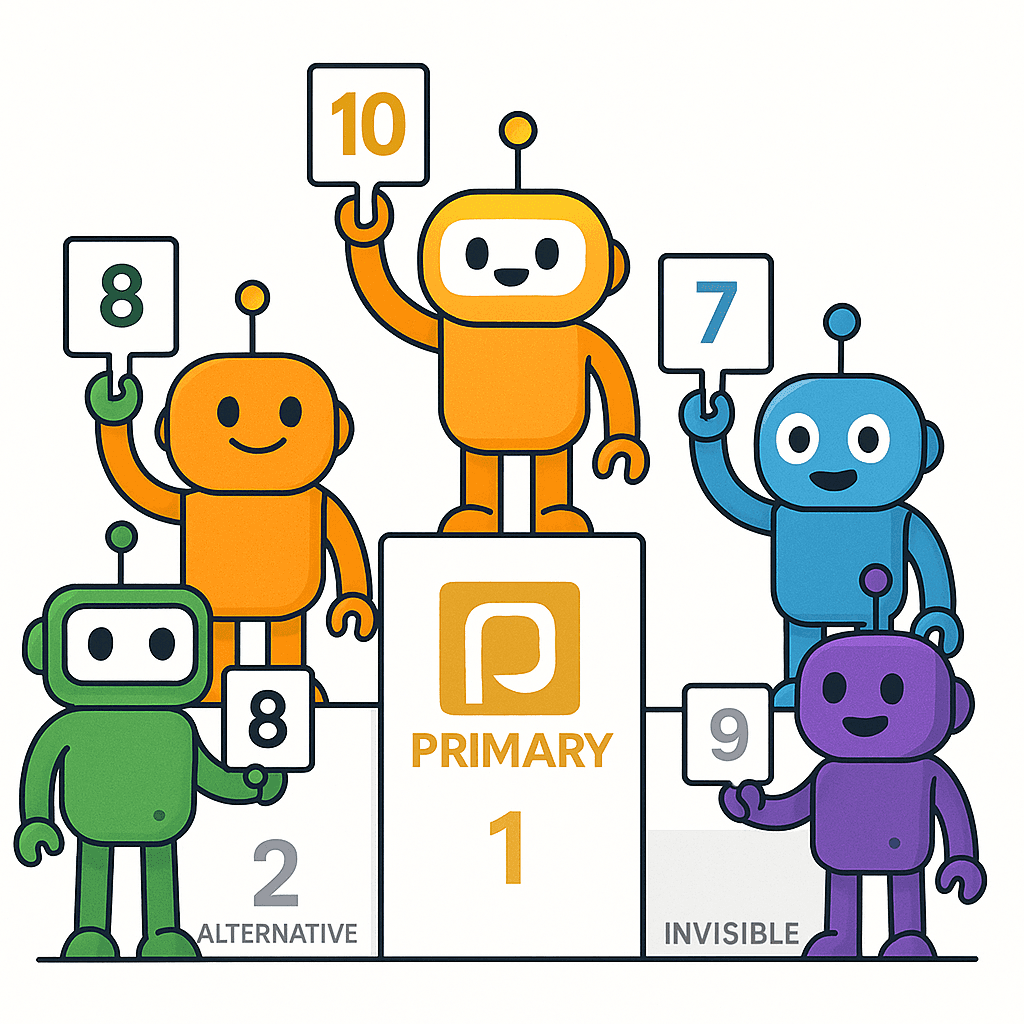
Getting mentioned isn't enough. Being relegated to "alternative" status is often worse than being ignored. Alternative brands receive 28% lower sentiment scores (0.58 vs 0.82) and are positioned as second-choice options.
The "Alternative Trap" affects 30 major brands in our dataset that consistently get mentioned but never get primary recommendations:
- Udemy — Always mentioned for online learning, never the first choice
- Wealthfront — Perpetual runner-up in robo-advisor discussions
- Dunkin' — Coffee chain also-ran despite massive brand recognition
- Agoda — Travel booking alternative, never the primary recommendation
These brands have visibility but lack authority. They're in the conversation but not driving it. Our analysis of content patterns shows specific strategies for escaping alternative status.
The Sentiment Premium: Top Shelf Brands Get Better Treatment
Average sentiment score by brand placement position
Industry Shelf Domination: Who Owns Their Aisle
Some industries have achieved near-total shelf domination, while others struggle for any visibility. The data reveals a clear hierarchy:
Complete Dominance (90%+ primary rates):
- Software Reviews — G2 owns 100% of primary mentions
- Customer Service Software — Zendesk commands 91.7%
- Telemedicine — Teladoc Health leads with 91.7%
Contested Markets (50-75% primary rates):
- E-signature tools — DocuSign vs alternatives
- Time tracking — Toggl vs Clockify vs Harvest
- Collaboration tools — Miro vs Figma vs others
The pattern is clear: B2B SaaS tools dominate AI recommendations while consumer brands struggle. This reflects AI training on technical documentation, developer discussions, and business software reviews — all areas where B2B tools have extensive, authoritative coverage.
Industry Shelf Ownership: Who Dominates Their Aisle
Percentage of primary recommendations by industry vertical
Mixed Shelf Personalities: The Brand Chameleons
The most fascinating discovery is what we call "Mixed Shelf Brands" — companies that achieve primary status on some engines while being relegated to alternatives on others. This affects 40 major brands in our dataset, revealing that AI engines have distinctly different "taste" in brands.
Take Slack: It earns 13 primary recommendations (mostly from Claude and ChatGPT) but gets positioned as an alternative 3 times (mainly by Perplexity). This suggests that Perplexity's real-time web search finds more current team communication options, while other engines rely on Slack's historical authority.
Or consider Instacart: Primary on ChatGPT and Gemini for grocery delivery, but alternative status on Claude and Perplexity. Each engine sees a different version of the same brand based on their unique data sources and ranking algorithms.
Split Personality Brands: Primary Here, Alternative There
Brands with mixed shelf positions across different AI engines
Engine Shelf Allocation Strategies
Each AI engine follows a distinct shelf allocation philosophy that reflects its underlying architecture and data sources:
Perplexity operates like Costco — high volume, generous sampling. It mentions the most brands (25.8% of all opportunities) because it searches the live web for every query. This real-time approach gives newer and smaller brands more chances to appear, but also means less consistency.
Gemini runs like a premium department store — selective but high-quality placement. It mentions only 14.4% of brands but gives them superior positioning (average rank #1.97). This selectivity comes from Google's Knowledge Graph, which requires established authority to get indexed.
ChatGPT resembles a traditional supermarket — balanced selection with clear category leaders. It maintains consistent mention rates (24.4%) and provides detailed alternatives, reflecting its training on comprehensive datasets.
Claude acts like a discerning boutique — most selective (21.8% mention rate) and most critical (lowest sentiment scores). Its conservative approach means fewer recommendations but higher accuracy when it does recommend.
Engine Generosity: The Shelf Space Allocation Strategy
Which AI engines are most generous with prime shelf real estate
The Shelf Space Optimization Playbook
Based on our analysis of 1,548 brands, here are the proven strategies for moving from stockroom to top shelf:
1. Become the definitive category answer
Our industry analysis shows that AI engines prefer clear category leaders over "also-ran" alternatives. Shopify doesn't just compete in e-commerce — it IS e-commerce in AI's mind. Focus on owning a specific use case completely rather than being good at many things.
2. Optimize for each engine's data preferences
- For Perplexity: Fresh, frequently updated content that appears in recent web search results
- For Gemini: Structured data, Google Business listings, and Knowledge Graph presence
- For ChatGPT: Comprehensive documentation, tutorials, and community discussions
- For Claude: Authoritative, well-cited content from trusted sources
3. Build citation authority
Our citation analysis reveals that brands with higher mention rates get cited from more authoritative sources. AI engines trust brands that other trusted sources trust. Focus on earning mentions in industry publications, case studies, and expert roundups.
4. Monitor and respond to shelf position changes
Brand sentiment in AI can shift rapidly based on recent news, competitor moves, or algorithm changes. Regular monitoring across all four engines helps you catch and respond to position changes before they become permanent.
5. Create engine-specific content strategies
Don't use a one-size-fits-all approach. Different prompts surface different brands, so create content that answers the specific questions your audience asks each engine.
The Zero-Sum Reality: AI shelf space is more limited than physical retail. When one brand wins top shelf placement, others automatically lose. Unlike Google's 10 blue links, most AI responses mention only 2-3 primary brands per category. Competition is intensifying.
The Future of AI Shelf Space
As AI adoption accelerates, we predict a "shelf space squeeze" similar to what happened when Google dominated search results. Early movers who establish category authority now will become increasingly difficult to displace.
Our winner-take-all analysis suggests that AI recommendations follow power law distributions — the #1 brand in each category will capture disproportionate visibility while #2 and #3 fight for scraps.
The brands that recognize this shift early and optimize for AI shelf placement will own their categories for years. Those that don't will find themselves perpetually stocked in the backroom, invisible to the millions of users who turn to AI for recommendations.
FAQ
What is AI shelf space and why does it matter?
AI shelf space is your brand's positioning in AI engine responses - whether you get "top shelf" primary recommendations, "middle shelf" alternatives, or remain invisible. Like retail, placement determines discovery. Our data shows primary brands average 82% higher sentiment than alternatives.
Which AI engine gives the most primary recommendations?
Perplexity is most generous with 6.5% primary rate, followed by Gemini (6.1%), ChatGPT (5.7%), and Claude (5.1%). However, engines have different personalities - Gemini is selective but treats mentioned brands better.
What industries dominate AI recommendations?
Software Reviews (G2) leads with 100% primary rate, followed by Customer Service (Zendesk, 91.7%) and Telemedicine (Teladoc, 91.7%). B2B SaaS tools generally perform better than consumer brands in AI recommendations.
Can brands be primary on some engines but alternatives on others?
Yes - we call these "Mixed Shelf Brands." Examples include Slack (13 primary, 3 alternative mentions) and Zoom (10 primary, 2 alternative). This happens because each AI has different training data and ranking algorithms.
How do I get my brand to top shelf positioning in AI?
Focus on: 1) Building authority in your category through quality content, 2) Getting mentioned on high-authority sites AI engines trust, 3) Ensuring consistent brand messaging across all platforms, 4) Optimizing for different engines' data sources (web for Perplexity, knowledge graphs for Gemini).
What's the sentiment advantage of top shelf brands?
Primary recommendations average 0.82 sentiment vs 0.58 for alternatives - a 41% boost. Top shelf brands also average 65.6% visibility scores vs 52.3% for alternatives. Position directly impacts how favorably AI describes your brand.
Visibility Score Premium: Top Shelf Commands Higher Scores
Average visibility score by brand shelf position