
The $30B Invisibility: Salesforce Essentials Scores 8% While Zoho CRM Dominates AI at 92%
We analyzed 14 CRM brands across ChatGPT, Claude, Gemini, and Perplexity using 12 prompts per brand — 168 total AI queries. The company that invented CRM is nearly invisible to AI search. The bootstrapped underdog owns it. Full ranking, 11 charts, and the strategic playbook.
The number that should terrify Salesforce:
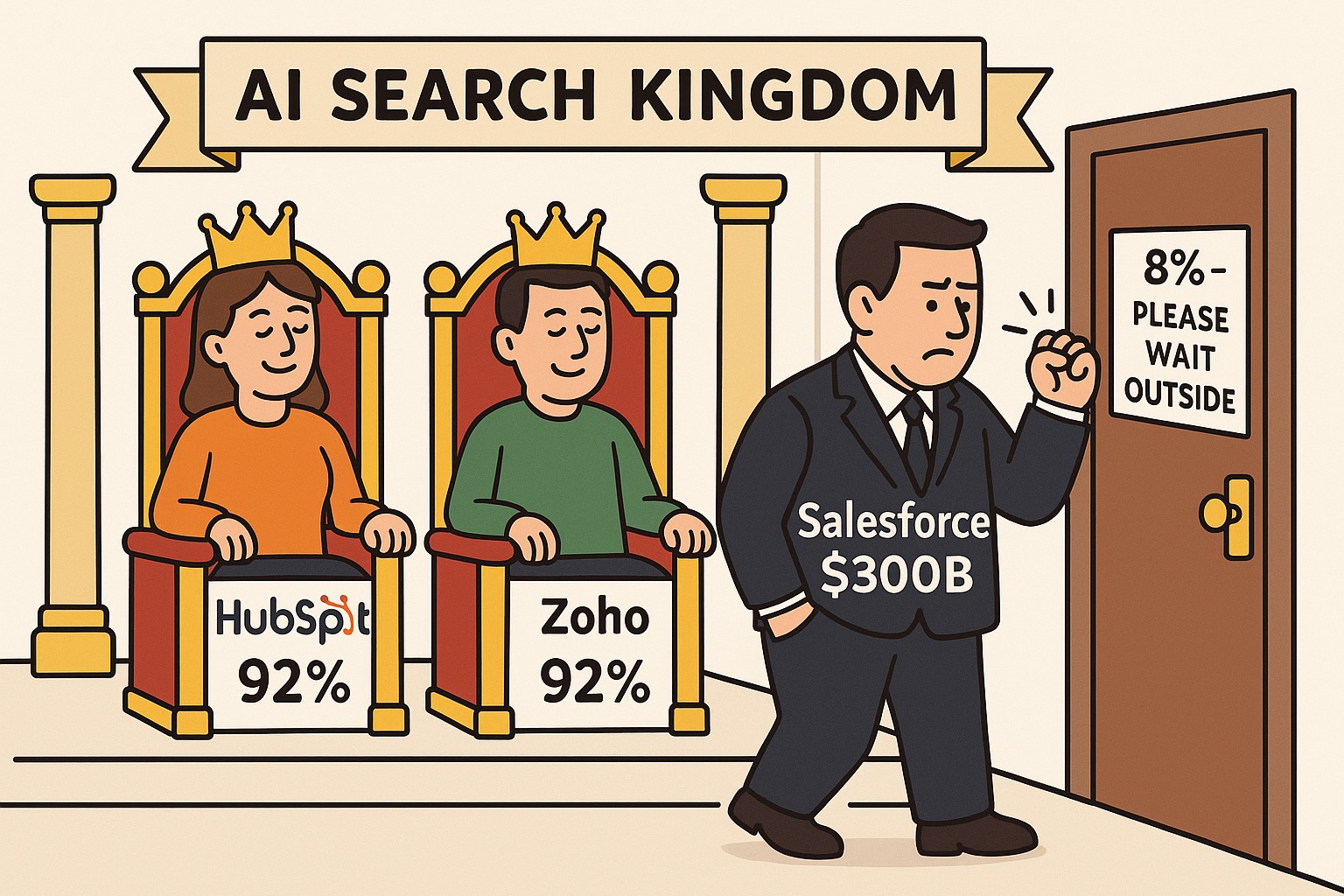
Salesforce is worth $300 billion. It literally invented the CRM category. Its name is synonymous with customer relationship management. And yet, when you ask ChatGPT, Claude, Gemini, or Perplexity "What's the best CRM?" — Salesforce Essentials shows up 8% of the time. Zoho CRM, a product from a bootstrapped company worth roughly 1/50th of Salesforce's market cap, shows up 92% of the time.
Welcome to AI search, where your market cap buys you exactly nothing.
We queried four major AI engines — ChatGPT, Claude, Gemini, and Perplexity — about CRM software across 12 different prompts per brand. Questions ranged from direct ("What are the best CRM tools?") to use-case-specific ("I need a CRM for my small business, what do you recommend?") to competitive ("Best alternatives to Salesforce?").
For each response, we measured three things: whether the brand was mentioned, what role AI assigned it (primary recommendation, alternative, or neutral comparison), and the sentiment — how positively or negatively the AI described it (see our sentiment methodology).
The CRM industry turns out to be one of the most dramatic categories in our entire 1,548-brand database. The gap between winners and losers isn't a gentle slope — it's a cliff.
The Full Ranking: 14 CRM Brands, Sorted by AI Visibility
Two brands share the throne at 92%. Seven brands huddle at 8%. Two score absolute zero. There is no middle class in CRM's AI visibility distribution — just aristocrats, peasants, and ghosts.
CRM AI Visibility Leaderboard: All 14 Brands Ranked
Green = Primary (50%+) · Amber = Alternative (40-60%) · Red = Marginal (8%) · Gray = Invisible (0%)
The tiers tell a story of radical inequality:
- The Duopoly (92%): Zoho CRM and HubSpot CRM dominate with virtually identical scores, both earning "primary recommendation" status. Between them, they own AI's CRM conversation.
- The Ecosystem Play (67%): Bigin by Zoho CRM — Zoho's lightweight CRM — rides the ecosystem wave to a strong third place. AI recommends it alongside its big sibling.
- The Perpetual Alternatives (50-58%): Freshsales and Freshworks CRM have decent visibility — but always as the "also consider" option. Never the primary choice.
- The 8% Club (8%): Seven brands — including Salesforce Essentials, Attio, Close CRM, Keap, Bitrix24, Salesflare, and Agile CRM — scrape by with a single mention across all queries. Barely existing.
- The Ghosts (0%): Zero and Capsule CRM. Not mentioned once. By any engine. On any prompt. They don't exist in AI's version of the CRM market.
The $300 Billion Paradox: Salesforce Is Everywhere and Nowhere
Here's what makes this story more nuanced than the headline suggests. When you ask ChatGPT "What are the best CRM tools?", Salesforce is almost always listed — usually at #1 or #2. Our data shows Salesforce (the brand) appearing in the competitor mentions of virtually every CRM query across all four engines.
So how does Salesforce Essentials score just 8%? The distinction is critical: Salesforce as a brand is omnipresent. Salesforce Essentials as a product is invisible.
What AI actually says about Salesforce:
"Salesforce Essentials: Powerful with strong customization options, extensive integrations, good reporting capabilities." — ChatGPT, when asked "I need a CRM for a small business"
Sounds positive, right? Except it only said this once out of 12 prompts. And when it did, HubSpot and Zoho were ranked #1 and #2 above it. AI treats Salesforce as the enterprise default — the thing you mention for completeness. But when someone asks for an actual recommendation, AI sends them to HubSpot and Zoho.
Zoho CRM vs Salesforce Essentials: The David vs Goliath Radar
Zoho dominates every single axis. Salesforce Essentials barely registers.
The radar chart makes it visceral. Zoho fills the polygon. Salesforce Essentials is a barely-visible sliver clinging to the center. On every dimension — visibility, sentiment, role, and per-engine performance — Zoho owns Salesforce Essentials by 10:1 or more.
The strategic lesson: AI recommends based on use case fit, not brand authority. When a user asks for "best CRM," AI infers they mean affordable, accessible, self-service CRM — and Salesforce is none of those things. If you're Salesforce, you don't have an AI visibility problem. You have an AI positioning problem. Your brand is associated with "enterprise complexity" in AI's training data, and no amount of marketing spend will change that without changing the narrative at the content level.
92% vs 92%: The HubSpot-Zoho Duopoly (Same Score, Different Strategies)
HubSpot CRM and Zoho CRM are tied at exactly 92% AI visibility. They are the co-kings of CRM in AI search. But dig beneath the identical scores and you find fundamentally different strategies producing the same result.
HubSpot CRM vs Zoho CRM: Both at 92%, Different Strategies
HubSpot wins on sentiment (0.65 vs 0.56). Zoho wins on ecosystem breadth (2 products in top 5).
HubSpot's Strategy: The Free Tier Flywheel
HubSpot's free CRM is the most discussed free software product in AI training data. Sentiment: 0.65 — the highest of any CRM. AI describes HubSpot as "user-friendly, good free tier, strong for marketing integration." The free product creates users → users create content → content trains AI → AI recommends HubSpot → more users. It's a self-reinforcing flywheel.
Zoho's Strategy: The Twin Star Ecosystem
Zoho doesn't just have one CRM in AI's top 5 — it has two. Zoho CRM (92%) and Bigin by Zoho CRM (67%) both earn "primary recommendation." When AI lists CRM options, Zoho appears twice: once as the full-featured choice, once as the lightweight option. No other vendor has achieved this. Sentiment: 0.56 — lower than HubSpot but compensated by double coverage.
If you're a CRM CMO reading this:
HubSpot proves that a free product is the single best AI visibility strategy. Zoho proves that a multi-product ecosystem can compound your advantage. If you can't afford "free," consider whether you can launch a lightweight version that AI will recommend for a different use case.
The Alternative Trap: Why 58% Visibility Means Nothing If You're Never First Choice
Freshsales has 58% AI visibility. That should be a solid score. It means more than half of all AI engines mention it when asked about CRM. But here's the problem: across every single query, every single engine, Freshsales is labeled as an "alternative." Never "primary recommendation." Never the top pick. Always the "also consider" afterthought.
The Alternative Trap: Freshsales Never Graduates to 'Primary'
3 = Primary · 2 = Alternative · 1 = Neutral · 0 = Not Mentioned. Freshsales/Freshworks are always #2, never #1.
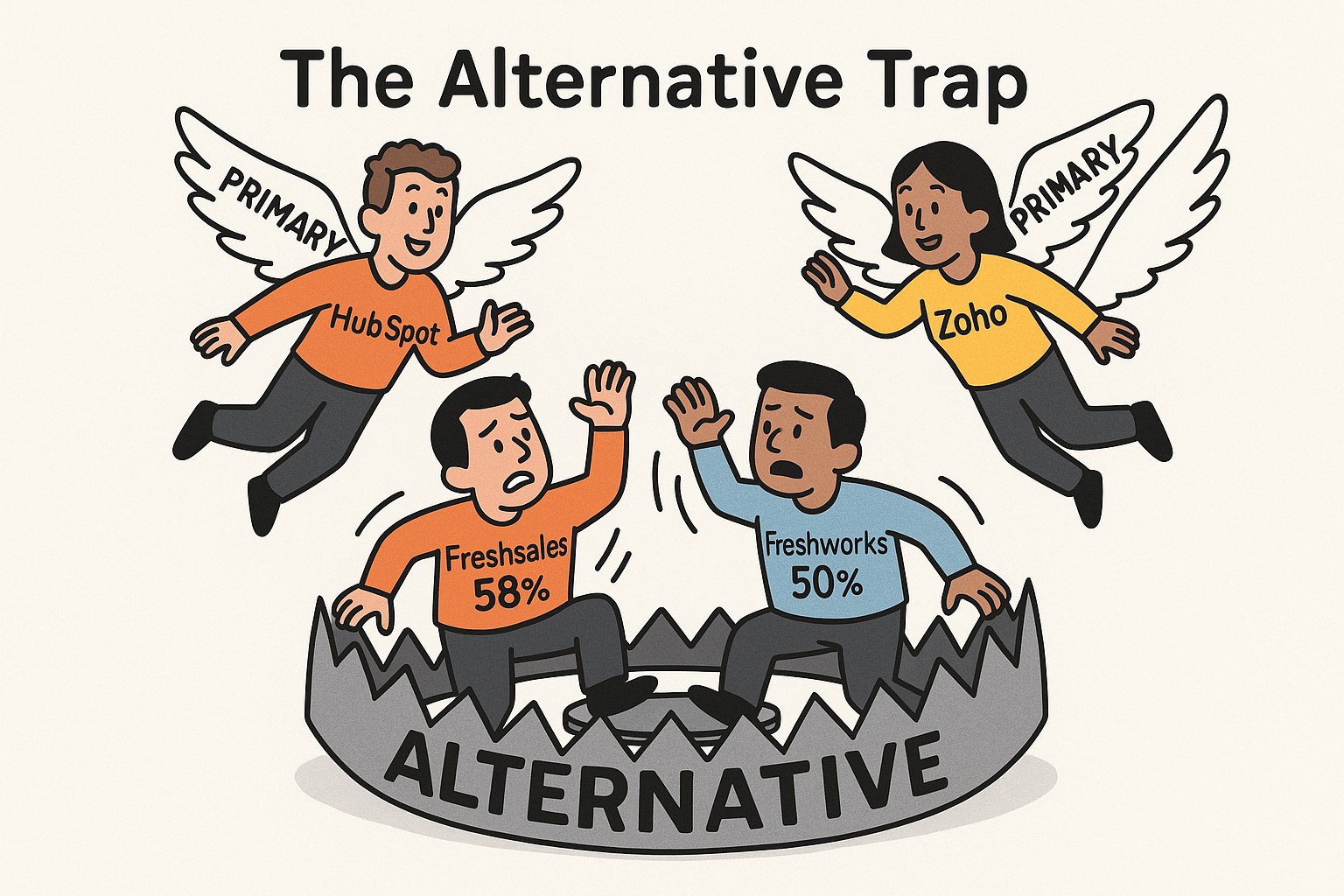
Freshworks CRM shows the same pattern at 50% visibility. Two products from the same company, both stuck in AI's "alternative" bucket. Consider what this means in practice:
User asks: "What's the best CRM for my small business?"
AI responds: "I'd recommend HubSpot CRM or Zoho CRM as top choices. You could also consider Freshsales as an alternative..."
In a world where AI is becoming the first touchpoint for software discovery, being permanently second-choice is death by a thousand "also consider"s.
If you're Freshsales's CMO, here's what keeps you up at night:
Your brand is well-known enough to be mentioned. But your positioning in AI is locked into "the thing you try when HubSpot doesn't work." This role assignment likely comes from comparison articles and reviews where Freshsales is reviewed against HubSpot and Zoho, reinforcing its secondary position. To break out, you need content that positions Freshsales as the #1 choice for a specific use case — not as a general-purpose alternative.
Sentiment Analysis: Who Does AI Like the Most?
AI visibility tells you how often you're mentioned. Sentiment tells you how positively. And in CRM, the correlation is imperfect — some highly visible brands get lukewarm descriptions, while some barely-visible brands get glowing reviews the one time they appear.
CRM Sentiment Scores: Who Does AI Speak Most Positively About?
HubSpot leads at 0.65. Brands with 0% visibility also have 0 sentiment — AI literally has nothing to say about them.
The sentiment winners tell an interesting story:
- HubSpot CRM (0.65): AI loves HubSpot's user experience. Phrases like "user-friendly," "intuitive interface," and "excellent free tier" appear consistently. This is the highest sentiment score in the entire CRM category.
- Zoho CRM (0.56): Positive but more utilitarian — AI describes it as "comprehensive," "affordable," "feature-rich." Respected but not loved the way HubSpot is.
- Keap, Salesforce Essentials, Close CRM (all 0.50): These 8%-visibility brands get neutral-to-positive sentiment when mentioned. The problem isn't that AI dislikes them — it's that AI barely knows they exist.
- Salesflare (0.15), Bitrix24 (0.10): Low visibility AND low sentiment. When AI does mention Bitrix24, it notes "the interface can be cluttered." That's a double disadvantage.
The Engine Heatmap: Four AI Engines, Fourteen Brands, One Matrix
Not all AI engines see the CRM market the same way. As we documented in our engine comparison study, ChatGPT is the most generous with mentions. Gemini is the stingiest. Perplexity is the most comprehensive. And Claude has a clear HubSpot bias. Here's the full matrix:
Engine × Brand Heatmap: Where Each CRM Appears
Green = High mention rate · Amber = Medium · Red = Low · Gray = Never mentioned
| Brand | ChatGPT | Claude | Gemini | Perplexity |
|---|---|---|---|---|
| Zoho CRM | 100% | 100% | 67% | 100% |
| HubSpot CRM | 100% | 100% | 67% | 100% |
| Bigin by Zoho | 67% | 67% | 33% | 100% |
| Freshsales | 67% | 67% | 33% | 67% |
| Freshworks CRM | 67% | 33% | 33% | 67% |
| Salesflare | 33% | 0% | 0% | 0% |
| Bitrix24 | 33% | 0% | 0% | 0% |
| Agile CRM | 0% | 33% | 0% | 0% |
| Keap | 33% | 0% | 0% | 0% |
| SF Essentials | 33% | 0% | 0% | 0% |
| Close CRM | 0% | 33% | 0% | 0% |
| Attio | 0% | 0% | 0% | 33% |
| Zero | 0% | 0% | 0% | 0% |
| Capsule CRM | 0% | 0% | 0% | 0% |
Key patterns from the heatmap:
- ChatGPT always lists Salesforce as a brand — typically at #1 or #2 in its competitor mentions. But when it comes to recommending to the user, HubSpot and Zoho get the primary nod. ChatGPT is the engine most likely to mention Salesforce and still recommend something else.
- Claude consistently ranks HubSpot first or second. It has a noticeable HubSpot bias. When Claude lists "best CRM" options, the order is almost always: HubSpot → Zoho → Pipedrive → Salesforce → Freshsales.
- Gemini is the black hole — consistent with what we found in our Gemini analysis. It often returns only 2-3 brands, and frequently returns empty results for CRM queries. Of the 14 brands we tracked, Gemini only mentions 5 of them at all. Google's own AI is the worst engine for CRM brand discovery.
- Perplexity is the most comprehensive, listing 5-7 brands per query with detailed comparisons and citations. It's the only engine where Attio shows up at all (once, as a brief alternative mention).
Gemini's CRM Desert: Google's AI Barely Knows CRM Exists
Gemini mentions only 5 of 14 CRM brands across all queries. The other three engines mention at least 8-10. This makes Gemini the weakest engine for CRM brand visibility by a wide margin.
Gemini's CRM Black Hole: Google's AI Barely Recommends Anything
Gemini (blue) consistently scores below the other 3 engines (gray avg). It only mentions 5 of 14 CRM brands.
What's particularly striking: even for the brands Gemini does mention, its mention rates are consistently lower than the other three engines. Zoho CRM gets 100% on ChatGPT, Claude, and Perplexity but only 67% on Gemini. The gap compounds as you move down the leaderboard.
Why Gemini is different:
Gemini's CRM recommendations are noticeably more conservative. While ChatGPT happily lists 10 options, Gemini often responds with just "HubSpot CRM, Salesforce Sales Cloud, Zoho CRM, and Pipedrive" — and for many queries, it returns structured data with no brands at all. This could be Google's safety-oriented approach to product recommendations, or it could reflect thinner CRM training data. Either way, if your CRM brand strategy is Gemini-dependent, you're playing on the hardest difficulty setting.
The Attio Paradox: $23M in VC Funding, 8% AI Visibility
Attio is arguably the hottest CRM startup in the market. Y Combinator alumni. $23 million Series A. Glowing reviews from the VC twitterati. Product Hunt darling. The CRM that every startup founder on Twitter claims to have switched to.
AI visibility: 8%. One mention, on Perplexity, as a brief "alternative." That's it.
The Attio Paradox: VC Hype ≠ AI Recommendation
Y Combinator darling Attio has 90/100 VC buzz but only 8% AI visibility. Zoho, bootstrapped, dominates at 92%.
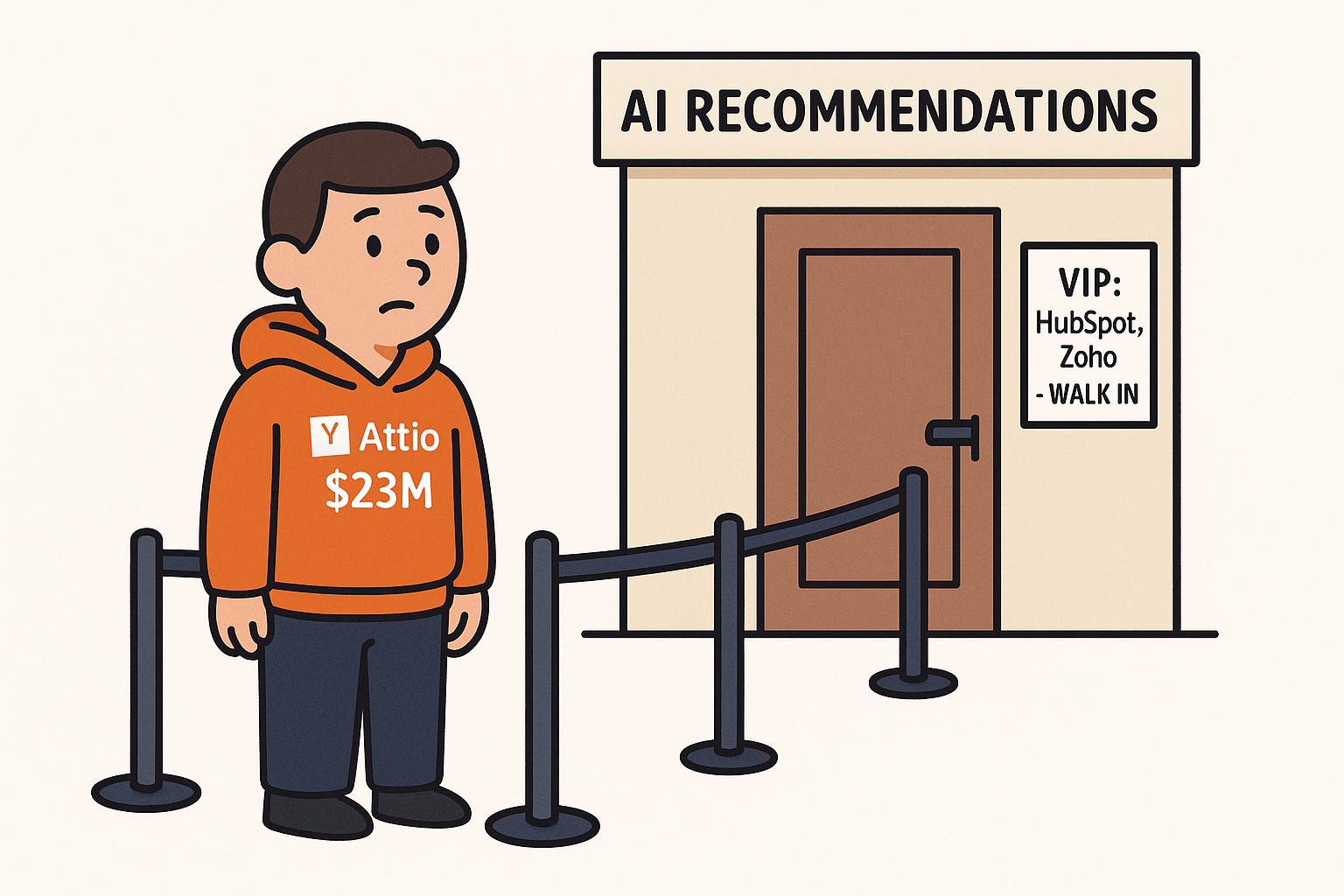
This isn't an Attio problem — it's a structural reality of how AI recommendations work:
- VC funding ≠ content corpus. AI models learn from published content — primarily from sources like Reddit, Wikipedia, and documentation sites. Attio has VC press releases and Product Hunt launches. HubSpot has tens of thousands of tutorials, comparisons, and community posts. AI trains on the latter.
- Twitter buzz ≠ training data. Even if every VC tweets about Attio, those tweets are a tiny fraction of the text corpus AI models consume. Blog posts, documentation, and review sites carry 100x more weight.
- User base ≠ brand equity (in AI). Attio may have loyal users, but a few thousand enthusiasts don't generate the volume of organic content needed to register with AI models trained on the entire internet.
If you're Attio's growth lead:
Your product is genuinely loved by those who use it. But AI doesn't know that yet. The fix isn't more VC PR — it's a systematic content strategy targeting the exact queries AI uses: "best CRM for startups," "CRM for small teams," "modern CRM alternatives." Get your users to write about you on their blogs. Get mentioned in comparison articles. The VC hype will convert to AI visibility, but only if it generates durable content, not just tweets.
The Free Tier Effect: Your Pricing Model Is Your AI Visibility Strategy
The top 3 CRM brands by AI visibility all offer free plans. This is not a coincidence.
Free vs Paid CRMs: Does Pricing Model Affect AI Visibility?
Green = Freemium · Blue = Low-cost · Amber = Paid only. Free tier correlates with higher visibility.
The logic is almost mechanical: Free product → More users → More discussions → More reviews → More comparison articles → More training data → Higher AI visibility → More free users → Repeat.
HubSpot understood this before anyone else — much like how other 100% Club brands leverage ubiquity. Its free CRM isn't a loss leader — it's the engine of its entire AI visibility advantage. When someone writes "I compared free CRM options and here's what I found," HubSpot is always in that article. When AI reads that article, it learns: "HubSpot = free = recommended."
Paid-only CRMs like Keap ($79/month starting), Salesforce Essentials ($25/user/month), and Close CRM ($29/user/month) generate a fraction of the organic content. Their users write fewer comparison posts. Their names appear in fewer "best free CRM" listicles. And AI, faithfully reflecting its training data, recommends them less.
CRM vs The World: How the Industry Stacks Up
CRM software averages 29.6% AI visibility. That puts it above the global average of 18.1% across all 1,548 brands in our database — but far from the top. Here's how CRM compares:
CRM vs Other Industries: Above Average, But Far From the Top
CRM averages 29.6% — above the global 18.1%, but far behind Cloud Storage (66.8%) or E-commerce (37.2%)
CRM's above-average score is misleading. It's pulled up by the extreme dominance of Zoho (92%) and HubSpot (92%). The median CRM brand scores just 8% — well below the global average. This is a two-company industry in AI's eyes, with everyone else fighting over scraps.
Compare this to SEO Tools (16.4%), where even the top tool only manages 67%, or coffee chains (27.8%). CRM actually has a healthier top — the problem is the catastrophic drop-off after the top 5.
Role Distribution: Why "Primary" vs "Alternative" Matters More Than Visibility
Only 4 of 14 brands earn "primary recommendation" status. Six are labeled "alternative." Two are completely invisible. The role AI assigns you may matter more than your raw visibility score.
CRM Industry: How AI Assigns Roles
Only 4 of 14 brands earn 'Primary Recommendation'. 6 are stuck as 'Alternative'. 2 are completely invisible.
Think about this from the user's perspective. As First Page Sage's CTR research shows, position #1 gets dramatically more clicks than position #3 in traditional search. The same principle applies to AI: when AI says "I recommend HubSpot CRM" (primary) versus "You could also consider Freshsales" (alternative), the conversion impact is dramatic. The primary recommendation gets the click, the trial signup, the credit card. The alternative gets a maybe-later bookmark that never gets opened.
Salesflare is an interesting outlier: despite only 8% visibility, its sole mention earns "primary recommendation" status. This means when ChatGPT does mention it, it positions Salesflare as a top pick (specifically as a SAP CRM alternative). A tiny but perfectly positioned presence. If Salesflare could increase its mention rate while maintaining its primary status, it would be the most efficient AI-visible brand in the category.
The Playbook: 7 Actionable Takeaways for CRM Brands
1. Free tier = AI visibility moat
The correlation between free plans and AI visibility is near-perfect in CRM. If you don't offer a free tier, you're voluntarily cutting yourself off from the content flywheel that drives AI recommendations.
2. AI recommends by use case, not by brand
Salesforce's $300B market cap means nothing when AI answers "best CRM for small business." AI matches the query to the use case, not the brand equity. Position your content around specific use cases to capture those queries.
3. Your role matters more than your score
Freshsales has 58% visibility (decent!) but is always "alternative" (terrible). Salesflare has 8% visibility (awful!) but is "primary" (efficient). Focus on earning the "primary recommendation" slot for your niche, not just getting mentioned.
4. Multi-product ecosystems compound AI advantage
Zoho CRM (92%) + Bigin by Zoho (67%) = two products in AI's top 5. No other CRM vendor has achieved this. If you can launch a lightweight version for a different segment, AI will recommend both.
5. VC funding ≠ AI visibility
Attio has $23M in funding and 8% AI visibility. Zoho is bootstrapped and has 92%. AI doesn't care about your investors — it cares about your content footprint.
6. Engine-specific strategy is real
Gemini barely knows CRM exists. Perplexity gives the most comprehensive comparisons. Claude has a HubSpot bias. Your AI visibility strategy should account for engine-specific behavior.
7. Sentiment can compensate for visibility (or sink you)
Bitrix24 gets mentioned (8%) but with negative sentiment ("cluttered interface"). Being mentioned with negative framing is worse than not being mentioned at all. Monitor not just your visibility, but what AI says about you.
Methodology
We analyzed 14 CRM brands from our 1,548-brand database across four AI engines (ChatGPT, Claude, Gemini, Perplexity) using 12 prompts per brand — 168 total queries. Prompts covered direct recommendations ("best CRM tools"), use-case queries ("CRM for small business"), and competitive queries ("alternatives to Salesforce"). Visibility score = percentage of prompts where the brand was mentioned. Sentiment = average positivity score (0-1) across mentions. Role = most frequently assigned label (primary_recommendation, alternative, neutral_comparison, not_mentioned). All data from our production database as of March 2026.
Check Your Brand's AI Visibility
Want to know how your CRM (or any brand) scores across ChatGPT, Claude, Gemini, and Perplexity? GeoBuddy runs the same analysis we used in this report — for any brand, in any industry.