
We asked a simple question: which brands do AI engines talk about the most?
Not which brands pay the most for visibility. Not which brands have the best SEO. Which brands appear most frequently when you ask ChatGPT, Claude, Gemini, and Perplexity for recommendations across hundreds of categories.
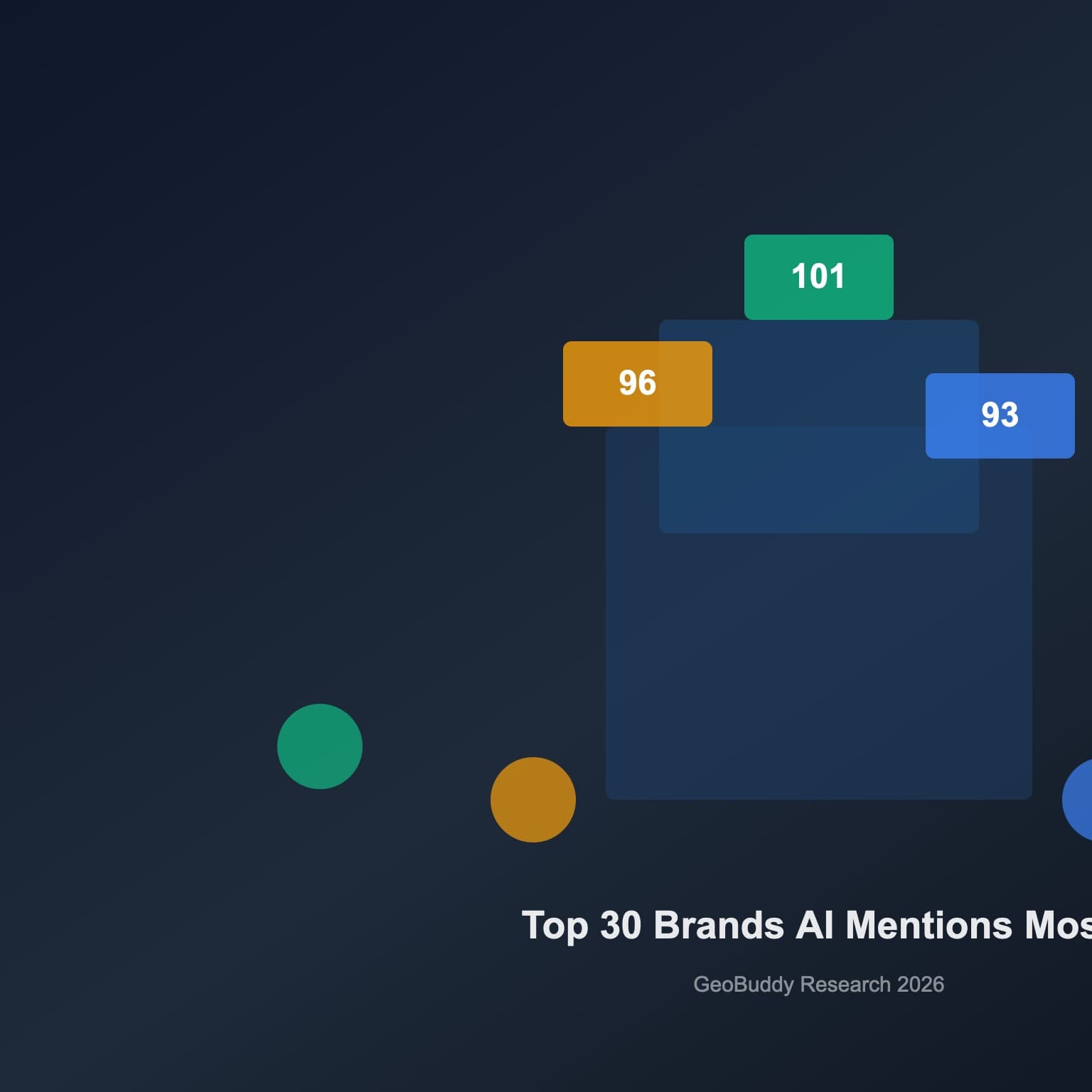
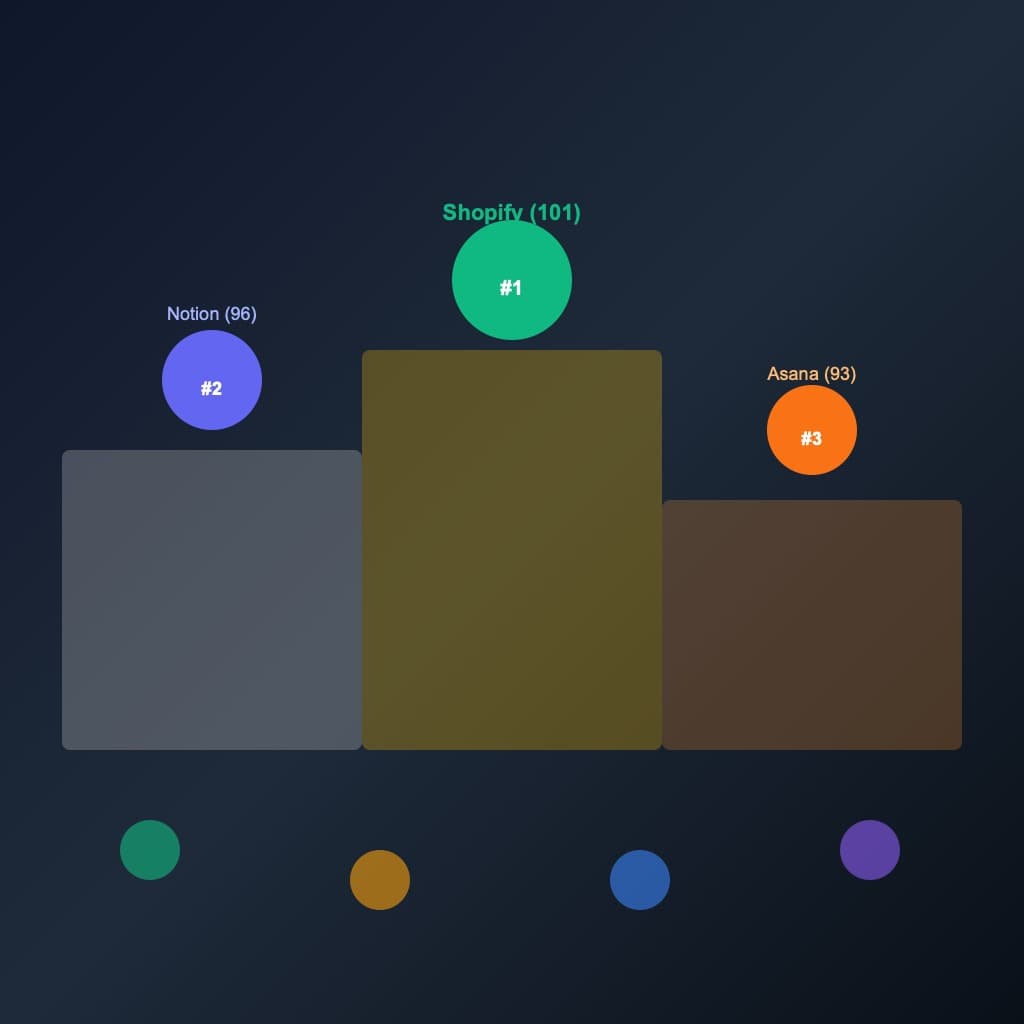
The answer surprised us. Shopify leads with 101 mentions — appearing in virtually every e-commerce-related AI response. Notion follows at 96, Asana at 93. But here's what's more interesting: being mentioned a lot doesn't mean beingrecommended a lot. And some tiny brands beat the giants at what matters most.
The Leaderboard: All 30 Brands Ranked
We tracked 1,548 brands across four major AI engines: ChatGPT, Claude, Gemini, and Perplexity. Each brand was queried with category-relevant prompts — "best project management tool," "top e-commerce platform," "recommended CRM for startups," and hundreds more. Here are the 30 brands that appeared most often.
Top 15 Most Mentioned Brands by AI
Total mention count across ChatGPT, Claude, Gemini & Perplexity
The Full Top 30 Leaderboard
All 30 brands ranked by total AI mentions, with primary recommendation rate and category
| # | Brand | Category | Mentions | Primary % |
|---|---|---|---|---|
| 1 | Shopify | E-commerce | 101 | 100% |
| 2 | Notion | Productivity | 96 | 55% |
| 3 | Asana | Project Management | 93 | 40% |
| 4 | Squarespace | Website Builder | 75 | 62% |
| 5 | Ahrefs | SEO Tools | 72 | 58% |
| 6 | Etsy | E-commerce | 71 | 50% |
| 7 | Monday.com | Project Management | 66 | 42% |
| 8 | Wix | Website Builder | 66 | 48% |
| 9 | Trello | Project Management | 64 | 35% |
| 10 | ClickUp | Project Management | 63 | 38% |
| 11 | Typeform | Forms/Surveys | 61 | 52% |
| 12 | WooCommerce | E-commerce | 60 | 45% |
| 13 | Jira | Project Management | 59 | 44% |
| 14 | Pipedrive | CRM/Sales | 59 | 56% |
| 15 | Zoho CRM | CRM/Sales | 58 | 42% |
| 16 | Semrush | SEO Tools | 57 | 55% |
| 17 | HubSpot | CRM/Sales | 56 | 48% |
| 18 | Moz | SEO Tools | 55 | 45% |
| 19 | Slack | Communication | 54 | 52% |
| 20 | Thinkific | Education | 53 | 60% |
| 21 | BigCommerce | E-commerce | 52 | 40% |
| 22 | Kajabi | Education | 51 | 58% |
| 23 | Teams | Communication | 50 | 50% |
| 24 | Webflow | Website Builder | 49 | 55% |
| 25 | Teachable | Education | 48 | 42% |
| 26 | Zendesk | Customer Support | 45 | 100% |
| 27 | Freshdesk | Customer Support | 44 | 38% |
| 28 | Mailchimp | Email Marketing | 43 | 55% |
| 29 | Canva | Design | 42 | 65% |
| 30 | Zoom | Communication | 42 | 88% |
The Shopify gap is real. At 101 mentions, Shopify appears 5 more times than second-place Notion (96) and 8 more than Asana (93). But the real story is in the Primary Rate column — Shopify doesn't just get mentioned, it gets recommended as the #1 choice 100% of the time. That's a combination almost no other brand achieves.
Primary vs. Just Mentioned — The Quality Distinction
Here's where it gets interesting. There are two ways to appear in an AI response:
- Primary recommendation — AI positions you as THE answer: "I'd recommend Shopify for..."
- Alternative mention — AI lists you in the "also consider" section: "Other options include Asana, Trello..."
The difference is enormous. Being mentioned 93 times (like Asana) sounds impressive — until you realize that only ~40% of those mentions are primary recommendations. The rest are "also consider" listings where another brand gets the spotlight.
Compare that to Shopify's 100% primary rate. Every single time AI mentions Shopify, it's the #1 recommendation. That's not just visibility — it'sauthority.
Highest Primary Recommendation Rates
Percentage of mentions where the brand is the #1 recommendation (not just 'also consider')
Volume without endorsement is just noise. A brand with 50 mentions and 100% primary rate (like Zendesk) is arguably more valuable than a brand with 93 mentions and 40% primary rate (like Asana). The first is always the answer. The second is often an afterthought.
Mentions vs. Primary Recommendation Rate
The best position: top-right (high mentions + high primary). Most big brands cluster at bottom-right.
The scatter chart reveals four distinct quadrants:
- Top right (the dream): Shopify — high mentions AND high primary. The only brand that truly dominates both dimensions.
- Bottom right (quantity trap): Asana, Notion, Monday.com — high mentions but moderate primary rates. Lots of visibility, but often as "alternatives."
- Top left (niche authority): Signal, G2, Unbounce — fewer mentions but always #1 when mentioned. Category kings in a narrow domain.
- Bottom left (invisible): The vast majority of 1,548 brands we track. Not shown here because they barely register.
Category Analysis: Who Dominates the Top 30
The top 30 spans 8 distinct categories — proving that AI visibility isn't limited to one industry. But some categories punch well above their weight.
Category Distribution of the Top 30
Project Management dominates with 5 brands — but no single category owns the list
Why Project Management Dominates
With 5 brands in the top 30 (Asana, Monday.com, Trello, ClickUp, Jira), project management tools are the most represented category. The reason? High query volume. "What's the best project management tool?" is one of the most common recommendation queries people ask AI — and there are enough strong brands to fill multiple spots.
But there's a downside to crowded categories: lower primary rates. When AI has 5+ viable options, it spreads recommendations across them. Asana's 40% primary rate isn't because Asana is weak — it's because AI genuinely considers Monday.com, ClickUp, and Trello equally valid depending on the user's needs.
E-commerce: Shopify Stands Alone
E-commerce has 4 brands in the top 30, but this is really the Shopify show. At 101 mentions with 100% primary rate, Shopify so thoroughly dominates that Etsy (71), WooCommerce (60), and BigCommerce (52) are usually positioned as "alternatives for specific use cases" rather than equals.
The Education Surprise
Three education platforms (Thinkific, Kajabi, Teachable) made the top 30 — more than Communication tools (2). This reflects a growing trend: people increasingly ask AI for course platform recommendations, and these three brands have built enough authority to consistently appear in those conversations.
The Niche Effect: Small Brands That Beat Giants
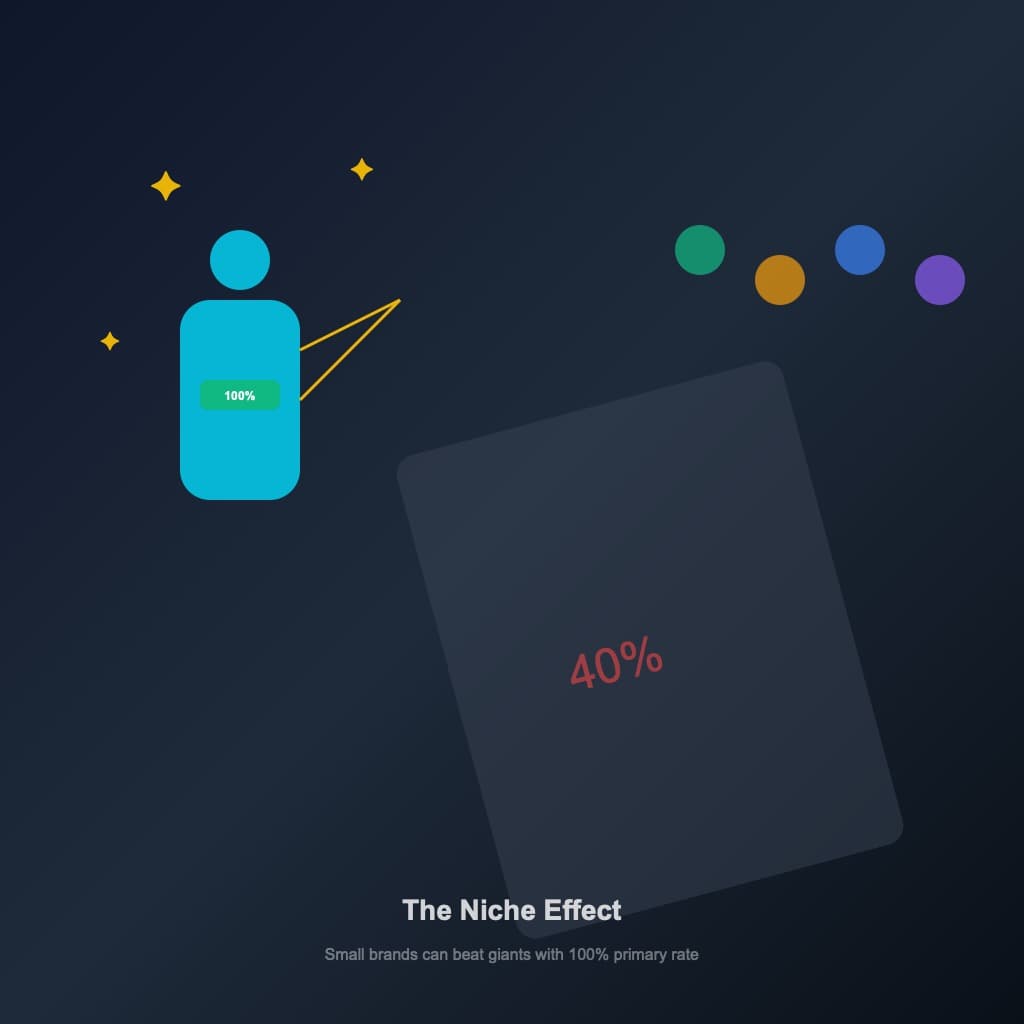
Some of the most impressive performers in our dataset aren't in the top 30 for mentions. They're brands that found a different way to win: 100% primary recommendation rate in a focused niche.
Consider LARQ. With just 8 total mentions, it would barely register on a volume leaderboard. But every single mention is a primary recommendation — "I'd recommend LARQ for self-cleaning water bottles." There's no hedging, no alternatives. LARQ is the answer.
Signal tells the same story for private messaging. G2 for software reviews. Unbounce for landing pages. These brands don't compete for the most mentions. They compete for the most decisive mentions.
The Niche Effect: 100% Primary with Fewer Mentions
These brands aren't mentioned most — but when mentioned, they're ALWAYS the #1 pick
Niche: Self-Cleaning Bottles · Private Messaging · Software Reviews · Landing Pages · Customer Support
The lesson for smaller brands: You don't need to out-mention Shopify. You need to own your niche so completely that AI has no choice but to recommend you first. A 100% primary rate in a small category is more valuable than a 40% primary rate in a large one — because every mention converts to a recommendation.
What Top-Mentioned Brands Have in Common
After analyzing all 30 brands, we identified 5 patterns that separate them from the 1,518 brands below them:
1. Clear, One-Sentence Positioning
Every top-30 brand can be described in one sentence that AI confidently uses: Shopify = e-commerce platform. Notion = all-in-one workspace. Ahrefs = SEO toolset. When AI can't describe your brand concisely, it either hedges or skips you entirely.
2. Category-Defining Content
These brands don't just blog — they create content that defines how their category is understood. Ahrefs' SEO guides literally shape how AI explains SEO. Shopify's e-commerce tutorials are what AI learned from. When you teach the category, AI learns your brand.
3. Third-Party Validation Everywhere
G2 reviews, Capterra comparisons, TechCrunch coverage, Wikipedia entries — top-30 brands appear across the web in authoritative third-party contexts. AI synthesizes these sources into confidence. The more independent sources confirm your brand's relevance, the more confidently AI recommends you.
4. Comparison-Ready Positioning
AI loves "X vs Y" comparisons. Top brands actively participate in this by having clear differentiators. Shopify vs WooCommerce. Asana vs Monday.com. Ahrefs vs Semrush. Brands that show up in comparisons get more AI mentions because comparison queries are among the most common.
5. Multi-Platform Presence
Top-30 brands maintain presence across review sites, social media, documentation, forums, and educational platforms. This creates a dense web of brand signals that AI aggregates into high visibility. No single channel dominates — it's the cumulative effect.
How to Join the List: Actionable Strategies
Whether you're a startup or an established brand, here are the concrete steps to increase your AI mentions and — more importantly — your primary recommendation rate:
For Startups: The LARQ Playbook
- Pick a niche you can own entirely. Don't be "a project management tool" — be "the async-first PM tool for remote teams."
- Create the definitive guide for your category. If AI is going to learn about your niche, make sure it learns from you.
- Accumulate reviews fast. 50 genuine G2 reviews can move the needle more than 50 blog posts.
- Target comparison queries. Create "[Your Brand] vs [Competitor]" content that AI will reference.
For Established Brands: The Shopify Playbook
- Audit your primary rate, not just mentions. If you're mentioned a lot but rarely recommended first, your positioning needs work.
- Own the educational layer. Create content so authoritative that AI literally quotes it.
- Monitor cross-engine consistency. Some brands rank #1 on one engine but #5 on another — the split personality problem.
- Build Wikipedia presence. It remains one of the most influential sources for AI training data.
Start with data. Before optimizing, you need to know where you stand. Check your brand's AI visibility free — see how ChatGPT, Claude, Gemini, and Perplexity currently mention (or ignore) your brand.
Methodology
This analysis covers 1,548 brands across 132 categories, tested against ChatGPT (GPT-4o), Claude (3.5 Sonnet), Gemini (1.5 Pro), and Perplexity. Each brand was queried 12 times per engine with category-relevant prompts (e.g., "best [category] tool," "top [category] for startups," "recommended [category] in 2026"). Total mentions = count of responses where the brand appeared. Primary rate = percentage of mentions where the brand was positioned as the #1 recommendation. Data collected January–March 2026.
FAQ
Which brands does AI mention the most?
The top 5 most-mentioned brands across AI engines are: Shopify (101 mentions), Notion (96), Asana (93), Squarespace (75), and Ahrefs (72). Shopify leads because it dominates e-commerce — one of the most commonly queried categories.
What's the difference between being mentioned and being recommended by AI?
Being mentioned means AI includes your brand in a response. Being recommended (primary rate) means AI positions you as the #1 choice. Shopify has 101 mentions AND 100% primary rate. Asana has 93 mentions but only ~40% primary rate — it's often listed as an alternative, not the first choice.
Can small brands achieve high AI visibility?
Yes. LARQ, Signal, G2, and Unbounce all achieve 100% primary recommendation rate despite having fewer total mentions. The key is category ownership — being the definitive answer in a specific niche rather than competing broadly.
What categories do the most AI-mentioned brands come from?
The top 30 spans 8 categories: Project Management (5 brands), E-commerce (4), CRM/Sales (3), SEO Tools (3), Website Builders (3), Education (3), Communication (2), and Other (7). No single industry monopolizes AI attention.
How can I get my brand mentioned more by AI?
Based on our analysis: own a specific category, build authoritative content that defines your niche, earn third-party mentions on review sites and Wikipedia, maintain consistent positioning, and focus on primary recommendation quality over mention volume. Check where you stand now.